




The Signal Insight
“You don’t have to understand quantum mechanics to understand the impact of what we do,” Niccolo de Masi insists. The CEO of IonQ, a company designing quantum computers to solve the world’s most complex problems, can talk at length about the properties of qubits or scientists like Werner Heisenberg, but he says his business should be no more impenetrable to investors and executives than a chipmaker’s.
“You probably have heard of companies like Nvidia and Broadcom, and I doubt that you know how to design a Blackwell chip,” he says.
Headquartered in Maryland, the self-styled Silicon Valley of quantum computing, IonQ boasts that it is the first quantum company to report more than $100 million of annual revenue. De Masi is up against the likes of Google and IBM, as well as specialist rivals D-Wave and Rigetti, but his ambition is to be the first to $1 billion in revenue, too.
That will mean persuading companies whose executives are still grappling with AI to start investing in a technology that few have begun to think about. The smarter CEOs are already making it their business to understand quantum, de Masi says. The rest, he argues, risk falling behind their faster-moving rivals. “Exponential curves sneak up on you,” he warns. “They always do.”
Here’s what he thinks CEOs should know about quantum, and why.
This interview has been edited for length and clarity.
Andrew Edgecliffe-Johnson: How should people who don’t understand quantum mechanics understand what’s coming?
Niccolo de Masi: Quantum mechanics is the world’s most successful physical theory because it produces the most accurate predictions. Since the Space Age, we have found those predictions are ever more important for unlocking the next leg up in the scientific revolution. Richard Feynman pointed out that quantum mechanics can be taken advantage of in several ways. If you can build a computer using the principles of superposition, then you should be able to come up with algorithms that [run faster]. You should be able to communicate information along networks with perfect security. And quantum provides alternative sensing capabilities. So we build the world’s most accurate atomic clocks that are commercially available. [With those clocks, we can build a] next-generation GPS that could be a thousand times more accurate than GPS is today.
Is that something you’re actively working on?
We’ve actively said we’re looking at it. I haven’t actively told you who we’re working on it with. GPS is accurate to about a meter, which is pretty good, but it’s not good enough for things like autonomy and self-driving cars. And there’s a whole host of applications that happen with much better precision. So our nation, other friendly nations, the Five Eyes, and NATO are really focused on three things. One, how do you make GPS more accurate? Two, how do you make GPS more resilient? Because it’s not very useful if the enemy can jam it or shoot it down. And three, how do you make sure that it is effectively faster? China has been investing heavily in quantum networking in space for the last five to eight years.
How do you compare where China is now [in quantum] to where you are?
I think China’s ahead of the rest of the world in quantum networking in space, if you look at published papers. So we are almost singlehandedly, for the Western world, investing in quantum key distribution and quantum security for the good of the NATO alliance.
That sounds like a mismatched competition, you against the whole of China.
It’s something that we’re seeing upticks in enthusiasm for from all parts of the transatlantic partnership. There was recognition by probably everyone at Davos, commercial and government, that quantum security is not just a nice to have. It is a matter of survivability. Imagine the world without GPS, and then imagine the world without your banking system. The reason China is investing so heavily in quantum computers is they want the ability as an offensive weapon to ruin our economy. If you can crack [the] RSA 2048 [encryption algorithm], the banking system goes, communication goes, telecommunications goes. What people don’t generally appreciate is that all of the hacks you read about today in the press are not actually cracking the fabric of the internet and the fabric of banking, the battlefield, the military. If that were to happen, it’s not a $100 billion economic hit, it’s like a $10 trillion economic hit, maybe more.
Every nation has put quantum in their top five priorities. This is the space race of our era. It’s the Manhattan Project of our era, and it’s existential if China gets the bomb before we do.
I think most CEOs see quantum as something that’s still on the horizon, but about 60% of your revenue comes from commercial customers. Who’s paying you and for what?
Banks and pharma companies are some of the most aggressive [customers], and then there’s a bunch of military, defense, prime contracting, aerodynamics, and defense intelligence applications I probably can’t talk about. Banks care about it because they know their brand goes to zero the second that they have a hacking problem. Telcos care about it because their brands go to zero if they get hacked. And AstraZeneca, Nvidia, and Amazon partnered with us last year to work on advancing computational drug discovery algorithms.
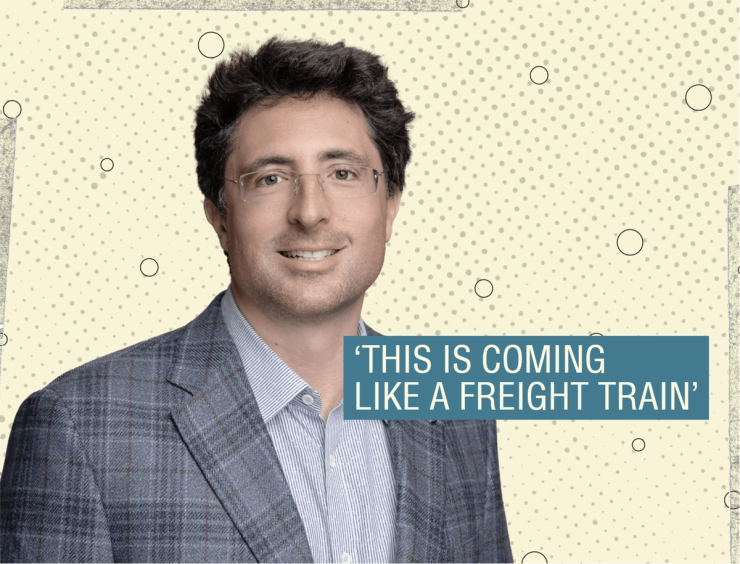
People do not understand how quickly it’s getting closer, because quantum computing doesn’t move forward at Moore’s Law, which is doubling every two years. Our machine moves forward by a factor of two every logical qubit. Not a single Fortune 500 CEO [that I’ve talked to] does not understand the security piece, nor shrugs off this as not something I should worry about. Because this is coming like a freight train.
And if you’re first in financial services or drug discovery or materials science, you probably have an advantage over your competitors. Even if it’s just a year of R&D, it’s still valuable. It’s a race. That’s the beauty of capitalism.
You’ve called IonQ’s team physicists who are also capitalists. You’ve been burning more cash than you’ve made: At what point do you have to turn to profitability over growth?
What tech investors care about is ecosystem breadth and depth, because they know that’s what builds the trillion-dollar company. I believe that there will be much larger quantum companies in the next five years than we’ve seen to date, and I am doing my best to make sure that IonQ continues to be the 800-pound gorilla of quantum. The history of tech in the last decade has been that there are compounding growth effects to ecosystem depth and breadth. So you’ve seen that these big tech companies people thought were too big to grow in 2010 are an order of magnitude bigger today, and the companies that had $100 billion market caps are now a trillion, and quantum has the same potential.
The cybersecurity challenge is where quantum comes up most often in my conversations with non-quantum CEOs. What’s your advice to CEOs who are trying to understand how to secure their companies?
Quantum security is cybersecurity. Eight-figure investments a year for large companies can get you a long way up this curve of resilience, and when you have a $100 billion market cap, that seems sensible to me.
There are debates on what year this is an existential crisis, but it’s coming by the end of this administration. [RSA 2048 doesn’t have to be cracked] for there to be a real stampede. And what I always remind CEOs and government leaders is this is relatively affordable compared to the risk-reward asymmetry. What’s the big deal if you invested three months early or six months early? Like, why would you take the risk? It’s like, if I’m going to kidnap your kids, do you care if it’s in 2028 or 2027? I use that analogy because the hostage-taking that happens today in cybersecurity is nothing like what it will be when you get a phone call that says, “I’m having all of it if you don’t pay me whatever.”

Notable
- Cambridge University has struck its largest-ever corporate research partnership with IonQ. A new quantum innovation center will house a 256-qubit IonQ system — the most powerful quantum computer in the UK — and aims to accelerate research in quantum science while driving commercialization of the technology.
- Computing’s prestigious Turing Award went this week to two men who created a way of keeping digital communication safe even in the age of quantum computers. “Quantum cryptography,” proposed by Charles Bennett and Gilles Brassard in the 1980s, relies on a quirk of subatomic physics: that observing a particle changes it.