Gulf economies could contract sharply this year as a result of the war with Iran, according to Goldman Sachs.
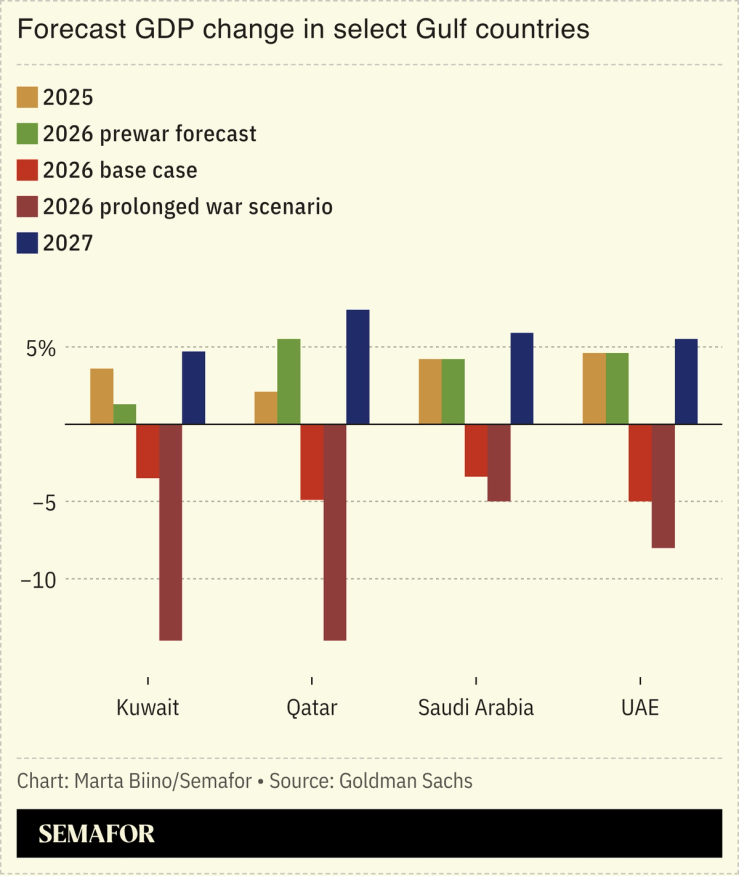
The bank’s base case, which assumes the Strait of Hormuz will be closed for most of March, forecasts that every Gulf economy will shrink this year by between 2% and 5%. In a prolonged conflict, with the Strait blocked until the end of April, the worst hit economies, Qatar and Kuwait, would contract by 14%.
Saudi Arabia’s ability to export some oil from its Red Sea port of Yanbu, and its lower reliance on expatriate workers and tourism, means it should be more insulated from the economic shocks than some of its peers, Goldman economists project. In a prolonged conflict the kingdom’s economy — the region’s biggest — could shrink by 5%, and the UAE’s by 8%.
The estimates broadly line up with those from other analysts that put Kuwait and Qatar most at risk because they rely entirely on the Strait of Hormuz for their energy exports, although both countries also have huge sovereign wealth funds they can lean on to support their economies. That’s not the case for Bahrain, which may struggle to recover from the impact of the war without a fresh bailout from its richer neighbors.
One bright spot from Goldman’s analysis: It forecasts a significant rebound in growth next year as oil exports return to normal and the region benefits from higher prices.