



Mishaal’s view
Today, a new crisis appears to be threatening the UAE’s positioning: Iran, unable to repel strikes by the US and Israel, has taken to attacking the Gulf in the hope of fomenting pressure on Washington to end the war. In what seems to be a testament to its stature, Tehran has devoted half of its attacks to the UAE.
To some, this marks the end of an era. The Emirati model, these critics argue, presumes a stability now lost; the implicit promise of peace in an unstable region has now been broken.
We have been here before, albeit perhaps not to such an extreme extent. After the 2008 global financial crisis and the Dubai property crash that followed, many argued that Dubai’s era was over. The regional instability of the Arab Spring ostensibly limited the UAE’s potential. COVID-19 at one point curtailed the migration the country is based upon.
Yet each time, the UAE emerged stronger. To understand why it will do so again, it is worth understanding those past crises.
Though the UAE — and the Gulf more broadly — is increasingly in the limelight, one should not assume that it has only just begun making long-term investments, or positioning itself as a global hub. Abu Dhabi long ago made investments in semiconductors (GlobalFoundries, 2006), renewables (Masdar, 2007), and civilian nuclear energy (Barakah, 2009). In some respects, Dubai started even earlier by betting on logistics (Dubai Ports World, 1979), aviation (Emirates, 1985), free trade zones (Jebel Ali, 1985 and TECOM, 1999), real estate (Emaar, 1997), and hospitality (Jumeirah, 1999).
Those down payments became particularly useful when that trio of crises — the crash, the Arab spring, and the pandemic — hit.
COVID-19 precipitated a strategic shift to geoeconomics: Under Sheikh Mohamed bin Zayed, Abu Dhabi retooled its economic statecraft, the UAE’s sovereign wealth funds reorganized, and new ones were set up; Abu Dhabi National Oil Company (ADNOC) modernized and became more aggressive; MGX, a technology-focused mega fund put itself at the center of frontier technologies like crypto, AI, and quantum computing. And under Sheikh Mohammed bin Rashid, Dubai’s “overbuilding” from 2008 became useful infrastructure for the post-pandemic boom, buffeting its status as a useful headquarters for global companies: Visa, for example, oversees 90 countries from Dubai, while both cities have attracted huge numbers of high net worth individuals and family offices.
That brings us to the present challenge, which mustn’t be trivialized: The UAE is bearing the brunt of a very particular calculus by Iran. Last week, I was texting with a friend who was flying out of Dubai airport as Shahed drones were incoming. Within 10 minutes of the evacuation order, an entire terminal had been guided to shelter; an hour later he had taken off.
Yet precisely what got the UAE through the previous crises — and what is getting it through the current one — is why I am confident the country will emerge from this moment stronger.
For one, collaboration, aided by proximity. While there are a few other well-run cities across emerging markets, what is rare is having two in the same country, to say nothing of them being this close to each other. 18 years ago I argued for the emergence of ‘Abu Dubai’, the de facto merging of Abu Dhabi and Dubai into one economic and cultural metropolis. Today, the undeveloped parts between them are just 25 miles, where the desert briefly interrupts the otherwise continuous corridor of ports, logistics zones, resorts, and suburbs. Dubai Holding and Abu Dhabi’s Aldar are now developing real estate together, Emirates Global Aluminum stands as a successful merger of the pair’s industrial champions, and the federal Etihad Rail network is physically tying their logistics corridors together.
For another, talent. “Abu Dubai” today is a Miami to many Latin Americans: Westerners are familiar with the rich setting up shop in the two cities. But beyond them, Central Asians, Africans, South Asians, Southeast Asians, Arabs, and Iranians call the UAE home (or, perhaps, a second home) as well as a primary base for business. Rivals — Indians and Pakistanis, Armenians and Azeris, Russians and Ukrainians — coexist, even if begrudgingly. In a sense the UAE is not a melting pot but a tossed salad — beyond leaving one’s politics at the door, there are no expectations of social conformity.
Why do they come and why do they stay? Because the UAE offers something that is in short supply globally — competent, predictable governance by a country courting migrants. What skeptics of the Emirates don’t understand is how rare this is. Faced with the prospect of an anti-immigrant West and a non-functioning rest, there are few places for the world’s population to go. Beyond Abu Dhabi’s museums and Dubai’s skyscrapers, what makes the UAE truly singular is that it works.
This crisis is trying. But so was the global financial crisis, so was the Arab Spring, and so was the pandemic.
I grew up in Dubai across the street from the central defense military base; by the time I graduated college it was replaced by Burj Khalifa. I moved to New York eight years ago to build a data startup. Today, I live four blocks from the Freedom Tower — once the site of the World Trade Center — and it’s not empty. “But you can’t compare New York to Dubai,” you may protest. Why not?
Sheikh Zayed believed a particularly rare idea: He prioritized value over control. So much of the poverty and regression of the world comes down to petty visions where one would rather own the majority of an atom over a sliver of a galaxy. Together with Sheikh Rashid, the architect of modern Dubai, he believed that sharing the wealth and the opportunity with an ever-expanding circle of people and capital would create greater opportunities for all involved.
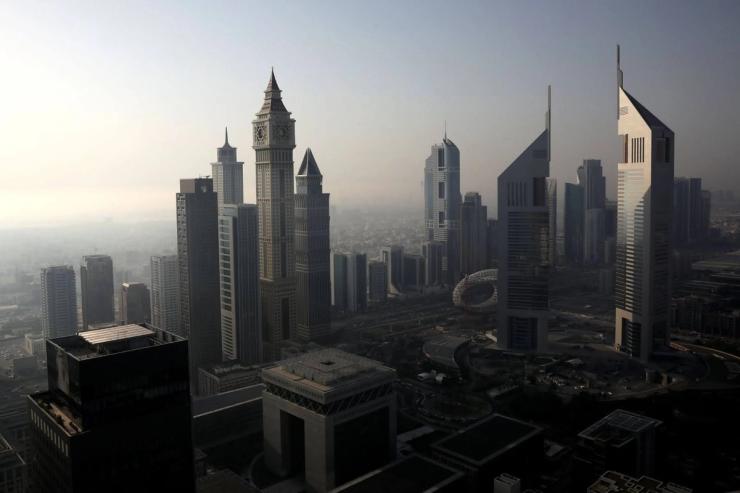
Much as the UAE had no business building the tallest tower in the world, it also had no business building a portfolio of investments and expertise across energy, logistics, real estate, health care, and finance, all while attracting people from all over the world. So long as the UAE stands, no emerging market country can tell its people why they too could not pursue greatness.
In today’s deteriorating world, there’s a need for a place that is more tolerant, open-minded, and experimental than most realize. Ultimately, the UAE exists because the demand for competent and civilized countries far exceeds the supply.
Mishaal Al Gergawi is an Emirati entrepreneur, and the co-founder and CEO of Axis, a platform that helps companies comply with regulations globally.

Notable
- The UAE is the antidote to the Islamic Republic: it has built a successful model built on integration and prosperity, while Tehran rejects the world and injects its version of religious rule, writes Bloomberg Opinion columnist Marc Champion.