




The Signal Insight
When Kyle Clark pitched his plans for BETA Technologies to Jeff Bezos, Amazon’s founder replied: “Oh, you know what you have? You have the ability to defer gratification.”
Now — almost a decade after Clark founded his electric aerospace business, five years since Amazon invested in it, and four months since he raised $1 billion in a New York listing — he may not have to wait much longer for his idea to take flight.
US federal regulators this week approved eight trial programs for what the industry calls “advanced air mobility.” What the general public calls flying taxis could be operating in 26 states as soon as June.
The CEO of Archer Aviation called it the industry’s “Waymo moment,” when people would get their first glimpses of a futuristic technology in action. But the initial boost to stocks of Archer, BETA, and rival Joby Aviation was short-lived. BETA’s earnings report this week showed that its losses swelled from $82 million to $452 million last year, though it ended the year with $1.7 billion of cash.
Clark, a Harvard engineer who wrote his college thesis on electric aviation 25 years ago, hopes to get the certification needed for his aircraft to carry paying passengers by the end of next year. Before then, he hopes to be making revenue from cargo flights for customers like UPS, his biggest to date. Vermont-based BETA has also struck defense-focused deals with GE Aerospace, which became an investor, and General Dynamics.
Clark is a proponent of “regret assist game theory,” or making plans based on avoiding the outcomes he would regret most: running out of money before realizing his vision, or losing control of his company.
One of his strategies has been to win over regulators and investors with test flights. Some are unsure until they see their colleagues take off, Clark says, but “they’re humans. They want to see their hard work materialize into something real.” In an industry “where there’s a lot of smoke and mirrors,” he says, “we deliver stuff.”
This interview has been edited for length and clarity.
Andrew Edgecliffe-Johnson: When is the general public going to be able to fly in one of your planes?
Kyle Clark: We have something called a market survey ticket, which we used to fly the first passengers into JFK this past year. We are allowed to fly you; we’re not allowed to take money to fly you yet. Later this year, we will be allowed to take money to fly cargo and medical, and I would expect sometime mid-to-late next year, we will be allowed to charge you to fly.
What have you learned about getting employees on board for an ambitious project whose commercial realization may be years off?
If you have people who have common passions but complementary skill sets, you make a good team, so [I asked myself:] What are the common passions that matter to us? You have to care about sustainability, you have to love aviation, or you have to have an insatiable interest in technology. If everybody has two of those passions, you always have one that overlaps with somebody else. And if you have common passions with people, you want to work with them. Let’s go fly together. Let’s go reduce the carbon in the atmosphere, or let’s go figure out how the hell this thing works.
What have you found is most effective at turning your vision into one that investors can share?
It’s “do real sh*t.” When people come to BETA I don’t ever give them a PowerPoint presentation. First I walk them in and show them an airplane, a motor, or whatever. And then we go fly, if we can. And you make it very, very real and very to-the-point. People get very connected very quickly.
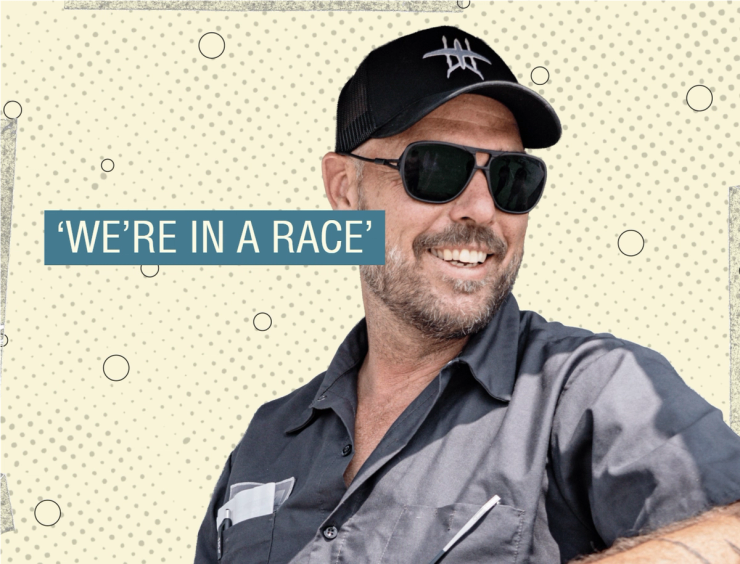
Investors will say, “Kyle, you have all the votes, you control the board, you fly the planes, you’re involved in the engineering decisions. That sounds like we need some more oversight and controls.” [My reply is,] “No, we’re in a race. We have to have efficient decision-making to be absolutely consistent.” The worst thing for an optimization algorithm is compromise.
It is mathematically really poor if you hedge. So the “burn the boats” mentality, which I know sounds extreme, really, really works. Even if I’m 51% sure of a technical decision, I will exude 110% surety. That drives the business with a tenacity and a clarity that you would never get if you walked out of [a meeting] and everybody knew, no matter how much you tried to hide it, that half the board wanted this, and half the board wanted [something else].
You’re in a race against better funded rivals. What do you need to do to compete against them?
Well, it’s funny that you say “better-funded,” because I joke when I’m hiring people here, “Hey, you just got a $450,000 engineering job in San Francisco. Enjoy your flat. I hope you can find a parking spot. For the job that you get here in Vermont, you’re going to get 50 acres and a house on the lake, and we’re going to pay half as much, by the way.” So “better-funded” is all relative.
It sounds like you’re saying your Vermont location has been a strategic asset.
The other huge advantage is that, in a highly regulated industry, your voice in Washington matters. As a small state, we still have two senators, and they sit on committees, and they can introduce bills. [Federal Aviation Administration timelines represent] the biggest uncertainty in our industry, so if somebody asked, “What’s your strategic advantage?” I’d say, we have proportionally the loudest voice in Washington. I mean, we’re [one of the most valuable public companies] in the state, and we have two senators.
You’re spending a lot of time in the air, in uncertified aircraft. What’s your directors and officers insurance policy like?
A lot of people have said, “We will invest in the business [but] you have to stop flying first flights, experimental airplanes, and flight tests.” And I say to them, “There are three-and-a-half thousand other companies to invest in.” That’s part of our secret sauce. When I look around the engineering team and say, “Hey, is this fit to fly? Let’s dive into it,” there’s an entirely different gravitas. So I don’t really care what the insurance policy costs. It’s less than the cost of not having that acute, visceral awareness of what’s right and what’s wrong about the airplane. I feel like I have one or two cards to play, and that’s one of them that’s non-negotiable here.
If I had all the money in the world, I would want to design, build and fly airplanes with awesome people around me, and that’s what I get to do every day. And if you want to take that away, I’ll go build a bus and live in the woods.

Notable
- BETA is accelerating development of its Alia MV250 military cargo drone by six months, with the first flight now expected this year, Clark told Reuters this week. “Big thematic tailwinds” from the Trump administration are compelling the company to invest further in defense, he said.