





Amena’s view
I never thought that the textbook example of a mega crisis in the Gulf would unfold in front of my own eyes. The US-Israel-Iran war has quickly evolved from a regional military confrontation into a global energy shock. The disruption of flows through the Strait of Hormuz has halted roughly 20 million barrels per day of crude exports — about 20% of global oil consumption. Prices surged to nearly $120 a barrel on Monday, and this reaction may still not have fully priced in the implications.
Last week, Qatar’s energy minister said crude prices could reach $150 per barrel within two to three weeks if tankers couldn’t pass through Hormuz. He warned that exporters across the Gulf would soon be forced to declare force majeure — Bahrain and Qatar already have. Surging prices from an energy supply crunch would then weigh on global economic growth.
As with most shocks, there are winners and losers. The closing of the strait is affecting Gulf producers unevenly and testing the limits of their contingency plans. Saudi Arabia, the UAE, and Iran have options to bypass the chokepoint. Bahrain, Iraq, Kuwait, and Qatar do not.
Saudi Arabia is in the strongest position. The kingdom can export about 5.5 million barrels per day through the Red Sea port of Yanbu using the 1,200 kilometer (750-mile) East-West pipeline. The UAE can ship as much as 1.8 million barrels per day from the emirate of Fujairah, also bypassing the Strait with a pipeline. Iran can route shipments through the port of Jask and part of its fleet is transiting through Hormuz anyway.
Iraq is the most exposed. About 94% of its 4.2 million barrels per day of crude production originates in the south and can’t be efficiently moved north to the Turkish port of Ceyhan. (Some 40,000 barrels per day at best can be trucked). Industry sources told me Iraq’s output has already dropped to around 1.7 million barrels per day, and could halt once storage is filled.
Kuwait faces similar pressures: the country has about 13 million barrels of crude loaded on ships that are stranded in the Gulf, and its 430,000-barrel-per-day Mina Abdullah refinery has been shut down following a drone attack. With limited storage capacity, industry sources estimate Kuwait’s output has already been sharply reduced. Bahrain and Qatar have effectively halted production of oil and LNG, keeping output at a trickle to avoid complete shutdowns that could damage reservoirs and delay restarts.
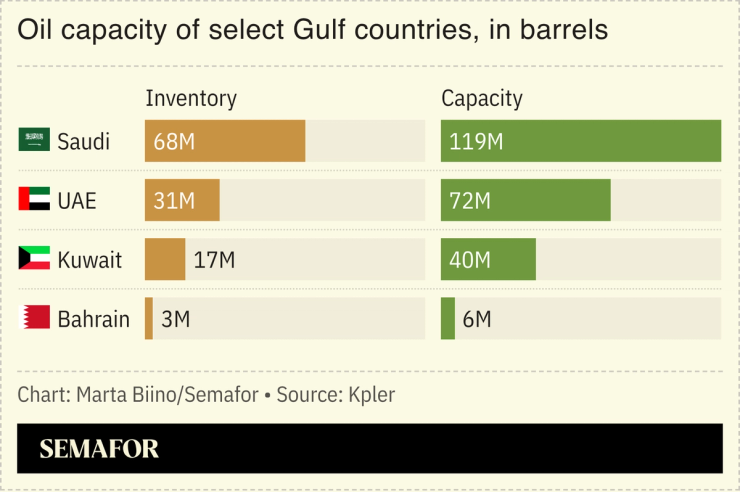
Even the countries with bypass options face limits. Saudi Arabia and the UAE could approach storage constraints within three to four weeks if tanker flows remain restricted, excluding Saudi Arabia’s underground storage capacity, which is not captured in current modelling. For now, neither country has reduced production.
Taken together, these storage dynamics point to a simple conclusion: If transit routes remain closed, widespread production shut-ins across the region will accelerate. A prolonged disruption will trigger a rapid contraction in global supply, with profound consequences for energy markets and the world economy.
US President Donald Trump suggested the conflict could last four to five weeks, but wars rarely follow predictable timetables. The administration may believe that the oil price shock will be short-lived and mitigated by providing naval escorts for tankers transiting Hormuz. But shipping experts say the complex and costly measure wouldn’t restore normal traffic quickly.
Trump’s insistence on securing a decisive outcome may lengthen the conflict. The administration framed the campaign not only as a military operation but also as a push to transform Iran’s political system. Based on the appointment of the late supreme leader’s son as successor, there are no clear signs of an imminent regime change in Iran.
For energy markets, the supply and storage calculus is clear. The world is now confronting a disruption that could reshape global oil flows and test the resilience of the international energy system in ways not seen for decades.
Amena Bakr is the Head of Middle East Energy & OPEC+ research at Kpler, an independent global commodities trade intelligence company.

Notable
- Saudi Aramco’s shares rose the most in more than two years as investors bet that the rise in oil prices could offset declines in exports, Bloomberg reported.