



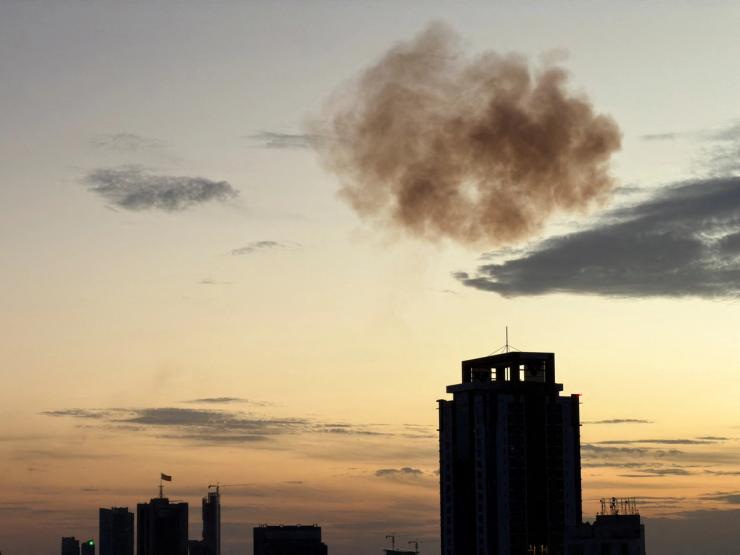

Mohammed’s view
The threat posed by Iran to the Gulf has existed for decades. But for everyone living here actual strikes felt improbable, something the Islamic Republic would never do because … well, for so many reasons that don’t matter now.
Dubai built the world’s tallest tower, Abu Dhabi styled itself the “Capital of Capital,” Doha hosted the men’s soccer World Cup, and Riyadh shed its austere Islamic posture to transform its economy and society. All the while, Tehran focused on centrifuges, missiles, and proxies, at the expense of its economy and people.
A week ago, our top headline was “Region preps for US strikes on Iran.” It was clear this was coming. What few expected was the scale — or direction — of Tehran’s response: more than 1,000 ballistic missiles, cruise missiles, and drones launched toward the Gulf. Most targeted the UAE, which is Iran’s second-largest trading partner. Even Oman, long Tehran’s back channel to the West, was struck.
Dubai in particular has long faced criticism for allowing trade with Iran’s regime. Last year, the financial center was forced to suspend companies linked to Iranian oil trader Hossein Shamkhani after a Bloomberg story exposed the network. If the name sounds familiar, it’s because he is the son of Ali Shamkhani, a close adviser to Iran’s late supreme leader who was killed alongside his boss in the initial US-Israeli strikes on Saturday.
While most of the Gulf’s ire is directed at Iran, there’s a growing frustration — including from billionaires and princes — that the US and Israeli Prime Minister Benjamin Netanyahu, have dragged the region into a war it neither chose nor wanted. Many question why Washington doesn’t consider the Gulf’s security and economic interests despite trillions flowing from the region into the American economy.
While the grumblings ring true, the alliance and investments did buy the Gulf an umbrella. A few deaths and dozens injured after a week of such intense firepower is a testament to the region’s air defenses, and that protection wouldn’t be possible without the US. The alternative? Look to the devastation of defenseless cities in Gaza, Lebanon, or much of Syria.
The week has shattered assumptions about the Gulf. But one constant likely remains: The region will continue to stand with Washington against a weakened, but still deadly, Iran. It doesn’t have much choice.

Notable
- Officials in Abu Dhabi are mulling freezing billions of dollars in Iranian assets held in the UAE, The Wall Street Journal reports.