




The Signal Insight
Bruising drops in software company stocks this year have left investors struggling to discern which firms will be least and most affected by competition from AI agents.
“They’re trying to figure out who’s the Amazon.com and who’s the Pets.com,” says Autodesk CEO Andrew Anagnost, flashing back to two symbols of the dot-com boom and bust. But “the rubric’s a little bit more complicated” now, he adds.
Anagnost says his San Francisco-based firm, which sells software to architects, engineers, and manufacturers, has three defensive qualities that will determine success in the agentic future.
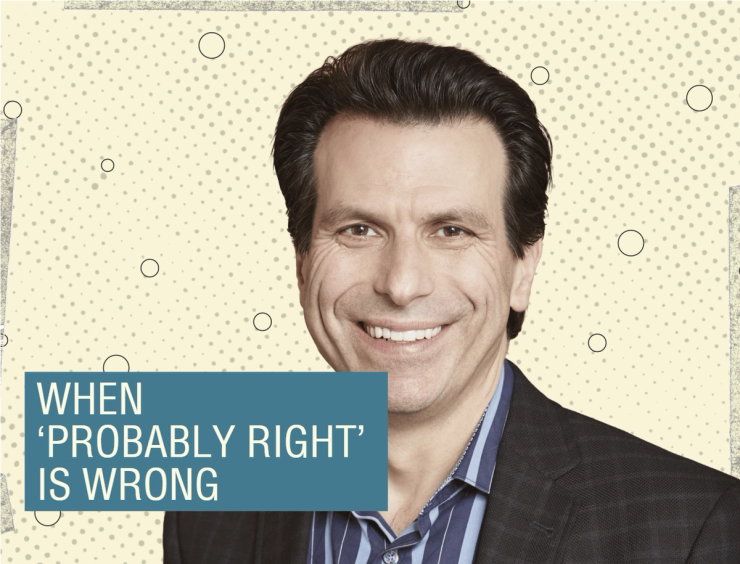
The software-as-a-service (SaaS) companies that manage to thrive, Anagnost argues, will be those in high-stakes industries where a supplier’s answers can’t just be “probably right”; those who serve clients operating in complex contexts; and those that possess both scarce data and the ability to apply expert understanding to that information.
“If you have a good moat, and you’re executing consistently, the market catches up to your output,” he says. Still, he’s doubling down on a strategy that he hopes will protect Autodesk if AI efficiencies cut the number of people its customers need to employ: He’s been moving more clients onto consumption-based or outcome-based pricing models, rather than user-based subscription plans that are vulnerable to headcount cuts.
Here’s how he defines his moat, and his plan for defending it.
This interview has been edited for length and clarity.
Andrew Edgecliffe-Johnson: It feels as though the AI story has changed enormously in recent months, both in the evolution of the technology and in the changes in market perception. How do you think about the evolution of the AI story within Autodesk?
Andrew Anagnost: Investors in general are struggling to decide what’s their rubric. How do they pick the winners and losers out of all of this? There’s a few hallmarks of moats: First, are [companies] dealing in a market where “probably right” is wrong? We, for instance, deal in industries where you can’t have “probably right” answers. You have to get to definitive answers, and you have to be able to get there without prompting [an AI model] 75 times.
Then you’ve got to look at what kind of context complexity the vendor is playing with. If the context isn’t complicated, then it can be disintermediated. In design, engineering, pre-construction, and manufacturing, there are specs, there are permitting codes, there are ordinances, and there’s disconnect between the disciplines, so the context is incredibly complicated.
The next thing is, [you need to] have the expertise, and the scarce data that you can deploy that expertise on. You have to have large volumes of vertically specific data that you can’t get off the World Wide Web, that is specialized to your industry. We sit on large volumes of complex design data, and we have the expertise to build our own custom models with that data.
We’re wrestling with that conversation now across multiple markets, and the truth of the matter is some of these SaaS vendors aren’t going to survive.
How are you thinking about the returns on your AI investments ?
This is a long game for us. We’ve been working on deep AI for almost a decade, and we just see ourselves progressively rolling this out to our customers over time. And we are going to enable our customers to have fewer people per project, because we want them to bid on more projects, win more projects, and execute more projects. Their [total addressable market] of projects is far bigger than any of them can reach with their current capacity.
We’re also moving into workflow automation [in a way] that allows us to monetize the project, not just the individual user. And we’re experimenting with systems-level automations that get us into the pocket of the person who is commissioning the asset, or is buying the product, and that’s a really powerful place to be as well.
Have you explicitly decided to shift your business model away from user-based pricing, on the assumption that AI heralds a future of fewer jobs and fewer subscriptions?
Subscriptions are going to be with us for a long time, but we were the first in our industry, over 10 years ago, to introduce consumption [pricing]. So a large chunk of our desktop products are sold to our largest customers on a purely consumptive basis. This has been a very deliberate, thoughtful process. We’ve been spending a lot more time planning and executing than worrying. And, over time, consumption-based, project-based, site-based, and outcome-based pricing is going to become a bigger chunk of the puzzle.
What’s the outlook for your own head count?
We are absolutely going to hire fewer people over time. We’ll continue to hire, but the rate and pace is going to slow. But we have too many things to do. I have the honor and privilege of working in a unique space that has a pretty intense capacity problem. I don’t see a world where we’re employing fewer people and building fewer things. I see us building more things. If you walked in my shoes for a year, you’d see how inefficient it is to build infrastructure, how inefficient it is to build buildings, how manufacturing in the US and in Europe is still too expensive to compete with other types of automated manufacturing. And when you look at those things, you don’t see jobs disappearing in those segments. You see us unlocking cheaper projects and more of them. Will there be some job dislocation? Absolutely. Total employment in the built world may not grow, but we need those people, and we need technology to make them a lot more productive. We are just not killing it right now on building things cost effectively.
Do you see evidence that investors are getting more selective?
I think it’s going to take time to play out. The smart money is going to start using the rubric I talked about to pick winners and losers. But it’ll take time for them to apply that rubric and get comfortable with the evidence they’re seeing. In the short term, markets are not so good at seeing where the long-term players are. You saw this through every technology change that’s happened. They tend to put their money in safe places and shift at the last minute. So let that play out.

Notable
- Morningstar downgraded its ratings for six software companies this week, including Adobe, Salesforce, and Shopify. Microsoft has the industry’s widest moat, Morningstar said, but “we think it is hard to recommend any software stock in this environment due to the extreme uncertainty.” There will be winners and losers in the AI era, it added, but some software firms risk “massive dislocation”.