




The Signal Interview
When Warren Buffett retired last year, Dan Amos became the longest-serving CEO in the Fortune 250. The longer the legendary investor ran Berkshire Hathaway, “the better I liked it, because it took the pressure off me,” says the man who turned Aflac into one of the largest US insurers and launched its talking duck mascot.
“Being tenured doesn’t mean a whole lot,” other than that you’ve done well enough not to be kicked out of your job, Amos deadpans. He has never missed a quarterly earnings target, he notes, as he’s watched Aflac’s stock price climb from 95 cents to more than $111, lifting its market value above $57 billion.
He’s spent 36 years at the top of the company his uncles and father founded in Columbus, Georgia, in 1955. And that’s given him longer than most of his peers to think about what makes someone an effective CEO.
At 74, Amos is 21 years younger than the previous holder of the most-tenured title, but he has plenty of Buffett-like aphorisms. “If you don’t get an answer, the answer is no,” he tells sales people who are tempted to think the opposite. Another favorite line for colleagues who sit on problems rather than flag them: “Bad news doesn’t improve with age.”
Amos thinks his own leadership has gotten better over time, but he discloses that he is getting close to handing over the reins.
“I’m already getting a time in my mind” to name a new CEO, he says. He isn’t revealing the name of the internal candidate he’s been grooming or specifying the likely handover date, but says it won’t be “this year or next year.” He serves at the pleasure of the board, he adds, “but they’re pretty happy with what’s going on.”
The CEO as readable Pied Piper
As Aflac prepares for its first new CEO since 1990, Amos has some advice on what the job entails. First and foremost, the role is about “creating a picture of what you want the company to be like, and then becoming a Pied Piper to get [staff] on board with it,” he says. And that requires the opposite of inscrutability.
Transparent communication — including his oft-repeated sayings — is critical, he believes. “I spend a lot of time trying to be very readable [because] I want people to feel secure about their jobs.” If people don’t know what their CEO is thinking, they start to worry about whether they’re doing a good job or not.
Amos’s solution is to “set guardrails, and as long as [people] stay in the guardrails, then I let them run.” That doesn’t mean that he stops monitoring his employees’ performance, but his way of doing so has changed.
“In my early years of being CEO, I would call people all the time to check on production and go through the buildings and see people, and I still do some of that. But in today’s environment, I write notes constantly to people, handwritten notes,” he says. He has learned that it’s easy to keep pushing people to perform and then forget to acknowledge when they have done something particularly well.
Companies have to celebrate their wins to guard against burnout, he says, and it’s “a big mistake” if leaders forget the personal touch in an increasingly AI-driven world.
The simple strategy that spawned the Aflac duck
The experiences that a long-serving CEO accumulates bring wisdom, Amos says. One insight that his decades in charge have clarified is that leaders should simplify their organizations as much as they can.
“One of the things that you run into as a CEO is everybody’s got a new idea. And some of the ideas aren’t bad, but you can’t do everything,” he says. Aflac’s success has come from “not being all things to all people,” he argues, citing the strategic decision that ultimately transformed his company’s brand.
When Amos became CEO, Aflac was licensed in eight or nine countries. But when he studied those markets, he realized that the life insurance business in the US and Japan was worth more than in the rest of the world’s countries combined. Pulling out of the remaining markets saved Amos enough money to launch his company’s first national advertising campaign, and with it, the Aflac duck.
The creature whose quack became synonymous with the acronym for the American Family Life Assurance Company of Columbus has become such a potent part of the Aflac brand that it comes as a surprise to hear Amos say the duck ads were the riskiest move of his career.
Back then, he recalls, insurance company ads all looked much the same. “It was steady as she goes, and no chances taken.” And the first campaign to feature the duck, in 2000, “didn’t really take off.”
But Amos has a reputation for not moving on from one project to the next until he is sure the first one is working. The company and its advertising team refined the commercials, and within two years Aflac’s US sales had doubled.
Stay in the herd while running towards the future
Amos is in the business of managing risk, so he has no problem with colleagues who start something that ends up failing. “What I get upset about is if you start something and it fails, and then you want to keep going and you keep losing money.” Near Aflac’s office is a site where five restaurants have opened, only to close, he observes: The lesson is to realize that “you should just cut your losses and do something else.”
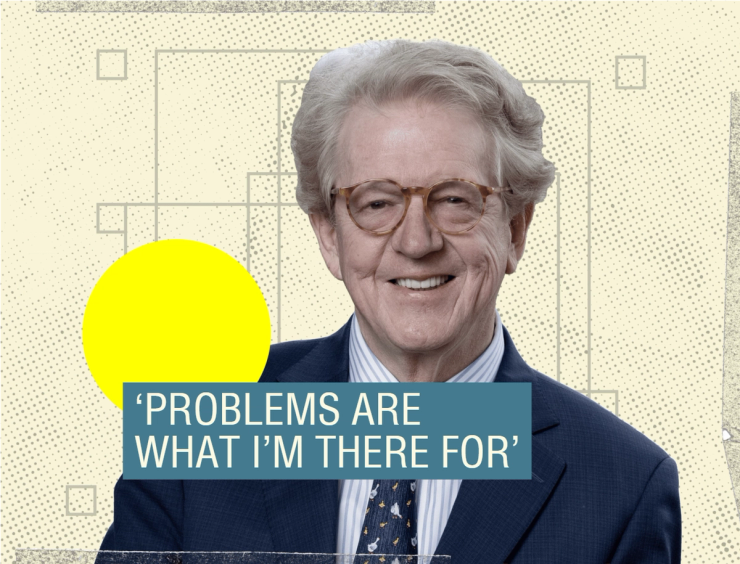
He recalls being told years ago that “if you don’t have problems, they don’t need you” — advice which encouraged him to embrace those moments of failure. “I look at problems [as] what I’m there for.”
Even as CEOs try to understand and monitor their risks, though, they need to be hunting for new sources of growth. And how they pursue them matters, Amos argues.
“I always say you can be in the front of the herd or the back of the herd, but you’d better be in the herd, because when you get outside the group, you can get shot,” he says. If you get too far in front of the pack, you end up spending too much money as you stumble through unfamiliar territory. Fall behind, and you can’t meet customers’ expectations.
Smaller businesses can take more risks, he adds, but with a company of Aflac’s size, “my main objective is to grow the business and protect it, not to grow it at any cost.”
Passing the baton ‘beautifully’
Another priority is to ensure a smooth hand-off to Aflac’s next CEO. “I want to be very careful who takes my place, because I want the baton passed off beautifully without any problems whatsoever,” Amos says.
As he rose through the company, he knew that his father and uncles wanted a family member to follow them, but it was never a given, he says. That pushed him to take a job where he could prove he was more than his surname.
“I decided to go into sales because it was objective, not subjective. If you put me in administration or I had gotten a law degree, you could debate whether or not I was doing a good job or not. But when you go into sales, then it’s pretty clear. You get a quota, you make it, or you don’t make it.”
In his first 10 years, selling Aflac’s products on commission in Alabama, sales for his area shot from $600,000 to $11 million. One second cousin works for Aflac now, but Amos is not expecting a relative to succeed him. “I have an internal candidate that I hope will one day be the next CEO. If he makes his objectives and does well, he most likely has a very good chance of being it, although the board will look outside too,” he says.
The risk when one person holds the top job for decades is that talented executives who aspire to be CEO get frustrated and leave. Amos says he has not had to see off any pretenders to his throne, though one unnamed earlier succession candidate “didn’t work out.”
Like Buffett before he named Greg Abel as Berkshire’s new CEO, Amos has kept his succession plans in writing for the past 10 years. He now updates his letter to the board quarterly, “because of my age,” telling directors how he evaluates various candidates’ performance and what he expects of them. The board adds its input, then shares a version with the individuals concerned.
Leaders can’t be insecure about somebody taking their job, he adds. “I’m at a point in my life [where], if they told me they didn’t like the job I was doing, I’d leave quietly. I would. I’m at a point where I gave it my best. If it ain’t good enough for you, then I’ll leave quietly. But do I like it? Yeah, I enjoy it.”
So much so, he adds, that he expects to “stay a few years” as chairman once the new CEO is named. It will let him do all he can to help his successor succeed, he explains. Besides, “I’m not going to make a very good retiree.”

Notable
- Corporate America will not run short of long-serving CEOs when Amos eventually steps back. Jensen Huang took the helm of Nvidia in 1993, and Steve Schwarzman founded Blackstone in 1985. Pat Gallagher, another long-tenured CEO of a family-founded insurance business, shared with me last year the mandate he got for keeping Arthur J Gallagher going for the past 30 years: “Don’t screw it up.”