




The Signal Interview
Sasan Goodarzi says he is driven by a paranoia that began when he was nine, when his family was told to “get the hell out of our country” in the buildup to the 1979 Iranian revolution.
“Not paranoid in a bad way,” he explains. “I always have had the fear of losing, and the fear of losing in life has always driven me to figure out, am I doing the right things?”
Shareholders in Intuit, the financial, tax, and business software company he runs, have felt something of that fear of late. Its market capitalization has been cut by 40% this year, to about $110 billion, as investor sentiment suddenly soured on software-as-a-service stocks. The sudden repricings suffered by the likes of Adobe, Oracle, Salesforce, and SAP have been dubbed the “SaaSpocalypse.”
Yet, in an interview shortly before the sector’s latest downwards lurch, Goodarzi was adamant that much of the value created in the AI revolution would flow to companies like his, because of their deep understanding of their customers. Intuit serves about 100 million consumers, businesses, and accountants with products including TurboTax, Credit Karma, QuickBooks and Mailchimp.
Breaking down the “AI stack” into energy, chips, infrastructure, and companies like his, that apply the technology to solve problems on customers’ behalf, Goodarzi predicts that much of the money now flowing to the first three categories will eventually shift to the fourth.
“The reality is, [large language models] are commodities,” he says. “Right now, all the investments are to build out the infrastructure, the chips, [and] the energy that you need to be able to run all these data centers. Eventually, it’s going to be the companies like Intuit that will benefit, because we’re delivering for the end customer.”
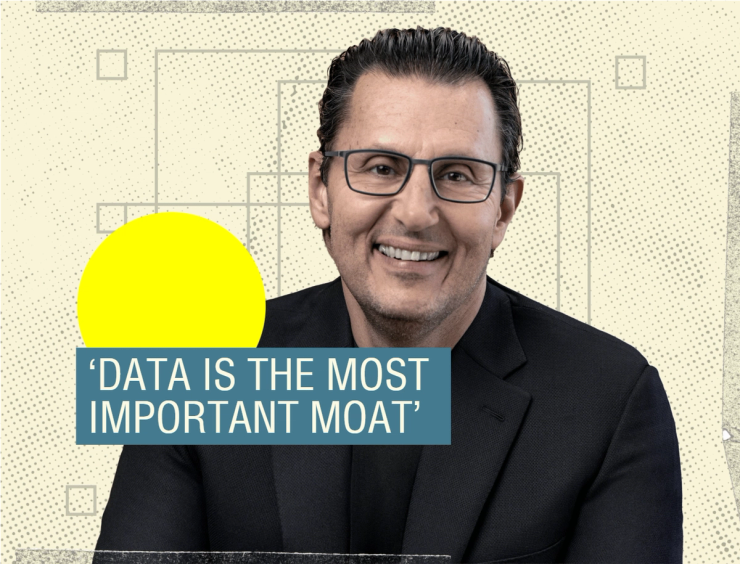
Goodarzi, who has struck deals with the likes of Amazon, Google, and OpenAI, bases his confidence on Intuit’s ownership of proprietary data that those companies currently lack. “Data is the most important moat in all of this,” he reasons.
The ‘burning platform’ theory of change
This is not the first time that Goodarzi has faced doubters. Seven years ago, when he stepped up from a divisional leadership role in Intuit to become CEO, he brought his top executives together for an emergency meeting. His message was that the company must reshape its strategy around a combination of data, AI, and “human intelligence.”
“At the time, I said that what AI will do will be bigger than electricity and will be bigger than the internet,” he recalls. “And many laughed at me.”
Worse than that, his senior leadership group was “absolutely divided” by the idea, he says, with half thinking that it made no sense to bet the company on an unproven technology and half agreeing with him that the shift in focus was essential. He didn’t fire the dissenters, he says, “because disagreement and diversity of perspective forces you to really catch your blind spots,” but “we had to change a lot of things to begin to execute, inclusive of talent.”
Many companies only woke up to AI’s disruptive potential when ChatGPT was released in November 2022. Goodarzi may have given Intuit a head start, but he recognized that he could use that milestone in the technology’s development into a new impulse for urgency.
He recalled the words of a former Nokia CEO, Stephen Elop, who told the handset-maker’s staff 15 years ago that they were like oil rig workers standing on a “burning platform,” and they’d need to jump into the “cold, foreboding” waters below if they were to survive.
Deploying the “burning platform” metaphor wasn’t necessary, Goodarzi recalls, “but I felt that it would be another ignition to us moving faster.” So he cancelled a planned trip, and told his top 30 executives they needed to come the next Monday with two-page memos filled with ideas “to move 10 times faster.”
Once again, about half of his team pushed back. But all of them shared their ideas, and ended up committing to the direction he set. “That galvanized the entire company,” he says.
Question everything to maintain a ‘day one’ mentality
Goodarzi describes those two moments as being critical in shaping Intuit’s strategy, but he has also sought to make challenges to the way it is working a part of its annual rhythm. Each year until 2025, he has gathered his senior leaders in December for a “question everything” meeting. The agenda is about “understanding what’s happening externally, and understanding where we’re trying to go, and then asking, do we have the right game plan,” he says. But that spirit extends to questioning routine moments in the corporate calendar.
Last year, he skipped the December meeting, because Intuit had announced a series of strategic shifts months earlier, and he thought that repeating the exercise would have been a waste of time. “You can’t just wait for your mechanism” to take action, he notes.
Goodarzi is a believer in the “day one” mentality popularized by Jeff Bezos’s mantra about Amazon’s need to maintain its startup vitality. “[On] day one in any job, you’re curious, you’re trying to learn, you’re trying to make an impact, and you’re not in love with whatever was in place before you,” he explains. So “every year we step back and say: [If] today was day one, would this be the system we would want in place?”
That approach can leave an organization in a state of perpetual upheaval, but Goodarzi thinks the risk is far outweighed by the danger of complacency. “I have never looked back and said, ‘I wish I would have gone slower,’” he says. “I have never looked back and said, ‘Boy, I wish we hadn’t done that when we did, because it created disruption.’ If anything, [I’ve regretted that] we waited too long.”
Even so, he adds, he watches for signs that there’s too much upheaval. “We don’t sit in an ivory tower and all of a sudden realize, oh my God, we took the company off the cliff.”
Technology and customer expectations are changing so fast, he adds, “that if you’re not three steps ahead, you’re going to lose the game.”
How to fall in love with the customer’s problem
2026 will be “a pivotal, consequential year” in which Intuit must bring its strategy around data, AI, and “human intelligence” to life, Goodarzi says. It narrowed its focus last year to three priorities: providing “done-for-you” experiences by automating work that customers would otherwise have had to do themselves; pursuing more mid-market business customers; and emphasising “the money benefits” in everything that Intuit delivers. (“It’s not about taxes, it’s actually about the refund,” he explains. “It’s not about accounting, it’s actually about better cash flow.” )
At the heart of all three is a focus on solving problems for the people who buy Intuit’s products and services. But Goodarzi tells his people to “fall in love with the customer’s problem, not with your solution to it.”
Intuit employees might delight in the operating system that they have put in place to solve a specific challenge in one of its market segments, he explains, but if that market changes, the system will be redundant. Focusing on the problem more than the solution helps companies remain curious.
“You have to be situational,” he argues. “And if there’s a dramatic macro[economic] and environmental change, you’ve got to pause and say, ‘Does that change anything in terms of what we’re doing?’”
Goodarzi believes in AI’s ability to disrupt established business models. But, he adds, “Companies that get disrupted are the companies that just ignore what’s happening, and they don’t question themselves as if it was day one.”

Notable
- Goodarzi looks for “grit” when he’s hiring, asking potential recruits “Have you had pain and suffering in your life?” He thinks books are a waste of time, he told a WSJ event this week, but if he had to recommend one, it would be Angela Duckworth’s Grit: The Power of Passion and Perseverance.