




The Signal Interview
Scott Strazik talks about the company he runs as a 75,000-person startup. GE Vernova, is less than two years old, but makes the turbines and generators on which a quarter of the world’s electricity supply depends. It traces its roots back to Thomas Edison’s first New York power station in 1882, but it only became an independent entity in April 2024, when the old General Electric empire split in three.
That balance of a decades-old history and a new brand’s need to establish itself in its own right shapes the leadership challenge facing Strazik, who joined GE in 2000 when it was still led by Jack Welch, one of the defining — and most debated — business leaders of the 20th century.
Even as GE’s operations sprawled across microwaves, television stations, and financial services, it seemed that everybody understood the intense, candid culture of accountability that defined its approach to management. Strazik’s task is to build a distinct culture for a much more focused business, at a very different time, while driving growth at a pace that GE struggled to find for years after Welch stepped down.
GE Vernova’s record so far looks more like that of a startup than a hulking industrial veteran. Last month it told investors it aimed to increase revenues by nearly 50% by 2028 from 2025’s $38 billion, while more than doubling profit margins. Its share price has risen more than fourfold since its listing, propelling its market capitalization to almost $200 billion — more than the value investors put on the entirety of GE before then-CEO Larry Culp announced his plan to split it up in November 2021.
Meeting a historic moment for demand
Strazik is clear that his ambitions have been helped by global electricity consumption entering what he calls a “supercycle” of accelerated growth.
“The world hasn’t had this much growth trajectory and need for electric power since World War II,” he says. For 30 years after 1945, the supply of electrons doubled every decade in Western Europe and the US, he explains, but then it flatlined as heavy industry moved elsewhere and software transformed productivity.
Now, decoupling supply chains are driving manufacturing growth in the West once more, electric vehicles and home heat pumps need to be plugged in, and the makers of AI’s large language models have ever-increasing power needs.
“AI needs the electron to meet the moment,” Strazik remarks. AI currently accounts for only 10% of GE Vernova’s order backlog, which increased by a quarter last year to $150 billion. But it could drive a third of its orders in the next few years, he estimates.
In the meantime, the breadth of demand “creates an opportunity, but it’s just that — an opportunity.”
With an installed base across gas, nuclear, wind and grid infrastructure, GE Vernova is well-placed to help electrify the world while simultaneously decarbonizing it, Strazik argues. But it must do so while also driving electricity’s affordability, “which is going to be a higher and higher drum beat from here.”
Signaling the need for change
Strazik worked in GE’s aviation engine and gas power businesses before taking over what was then GE Power in 2021. As a veteran of America’s best-known industrial conglomerate who spent years watching it struggle, he has sought to keep the best of its old culture while challenging GE Vernova to deliver more consistent performance.
That started with choosing the name for GE Vernova, a portmanteau meant to signal a commitment to green innovation. “We needed to tell our 75,000 employees, but also our customers, our partners, [and] governments, that the world was changing and we needed to change with it,” he explains.
Another early change was more than symbolic, he says. GE’s power business had been anchored since the late 19th century in Schenectady, New York. Three years ago, Strazik announced that GE Vernova’s headquarters would instead be in Cambridge, Massachusetts, the home of Harvard University and MIT.
Strazik saw the need to attract the next generation of talent to an industry that most graduates of elite institutions have been ignoring, he says.
“I had spent a lot of time talking to really highly motivated 20-something-year-old kids [who] would say their generation’s greatest challenge was climate change. Then when I asked them what job they were taking, it was social media. No issue, but we needed to draw people into our industry.”
Three months ago, GE Vernova struck a $50 million partnership with MIT, covering research funding, graduate student fellowships, internships, and professional development programs for its own executives.
Focusing resources on ‘the point of impact’
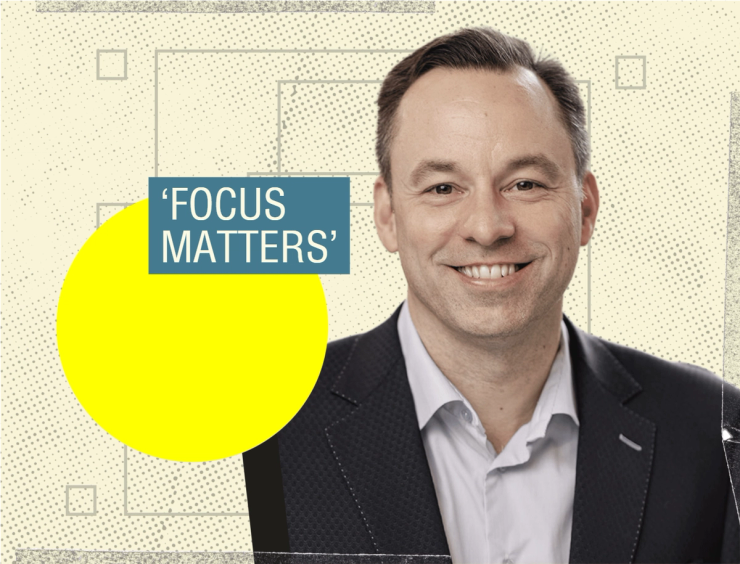
Asked what has driven the market’s repricing of GE Vernova and its former sister companies, GE Aerospace and GE Healthcare, Strazik replies: “Focus matters.”
He can look at his customers now and say, “The money you’re giving me, I’m going to give it back to you in the form of reinvesting in this company in products that will serve you in the future. You don’t have to worry about that money you give me for that order going to health care equipment or aircraft engines,” he says.
That is not always the case in a 300,000-person conglomerate. “The reality is, when you’re part of a big company, sometimes you cannot be certain who the wizard behind the curtain is making a decision.” There is no such ambiguity inside GE Vernova, he says, which allows it to move at a speed that is better suited to the needs of its fast-moving market.
A smaller balance sheet can also make focus a necessity. Once GE Vernova spun off with its own New York Stock Exchange listing, Strazik says, “we didn’t have the resources for hobbies.”
Even a 75,000-person company is big enough for people to spend time and resources on too many things that add little value, he notes. Addressing that problem has required “authentic adult conversations” with leaders in the company on what matters and what doesn’t.
That approach “can lead to hard feelings because then it can be perceived as a critique of what people were doing yesterday versus what we really need them to do tomorrow,” he says. But “we didn’t have the resources for allocation of time and energy on things that weren’t at the point of impact.”
As GE Vernova’s cash flows strengthen, Strazik is placing bigger, longer-term bets on serving the demand “supercycle,” from Saudi Arabia to Taiwan. He has pledged more than $600 million of investments in its US operations, chiming with the Trump’s administration’s drive to boost domestic manufacturing. And he’s steered part of a $5 billion research and development budget towards building small nuclear reactors that his company hopes to deploy across the developed world over the coming years.
It’s about balancing “making more of what we know how to make” with taking advantage of strong demand to invest in the next decade and moving the company forward, Strazik says.
“I’ve spent my adult life in GE. I’ve done that because I always loved the ambition of the company and I always loved the people that I interacted with. That said, there are things we needed to change.”

Notable
- The Trump administration’s efforts to halt construction of all US offshore wind projects are weighing on GE Vernova’s wind division. The unit recorded higher losses than expected last quarter after Washington issued a stop-work order for projects including Vineyard Wind 1, located off Martha’s Vineyard.