




The Signal Insight
When Christophe Weber became CEO of Takeda Pharmaceuticals in 2015, one Japanese newspaper put the word “betrayal” on its front page. A Frenchman taking command of one of the country’s flagship companies was a shock.
Straight away, people started asking how long he would stay, “because foreigners don’t last very long in Japan,” he recalls. He replied that he planned to be in the role for a decade, because that was enough time to make the changes he thought were needed.
It was never a contractual agreement, and the deadline slipped a little, but a year ago this week he announced that he would hand the company over to Julie Kim, the current president of Takeda’s US operations, in June 2026. She will be the first woman and the first American to lead Takeda in its 250-year history. Weber, who will retire this summer, is credited with having transformed Takeda into a globally competitive biopharmaceutical R&D company.
Here’s how he describes the thinking that went into his succession planning, the way he sees AI transforming his $55 billion company’s clinical trials, and the lessons from his landmark deal as CEO — the $62 billion acquisition of Shire, completed in 2019, which still ranks as the largest takeover by a Japanese company.
This interview has been edited for length and clarity.
Andrew Edgecliffe-Johnson: How did you approach the succession planning process?
Christophe Weber: We decided to choose the best moment for a transition [based on] the business situation of the company. And, of course, my successor being ready and me also being ready to move along. So we started discussing potential timing back in 2021 [when we said] that would be a three- to six- year horizon. It was a bit broad, but we started to really discuss how we would manage the process [then], and we zoomed in on the June 2026 date three years ago.
What were the most important factors that you were considering?
I was ready to make a change, [and] we are in a transition in terms of business cycle. We just had a very tough period of generic cannibalization of our business over the last three years. It’s finished now, and we are about to launch three new products, if not more. So in terms of the pipeline [of new drugs], it was a very good moment, because we are about to enter a super exciting period. Then we had developed internal successors, and it was a deliberate move back in 2022 to have two potential internal successors. Then another consideration is that we have a 10-year limit in our internal independent director mandate. So there will be some rotation of the board in 2026 as well. And it’s good for a new CEO to also start with a new board and recruit independent directors.
You wanted to set your successor up for success?
Absolutely. We announced my successor in January last year, so it was a long transition, because we wanted to be very open so that there would be no rumors, no potential destabilization. It also allows my successor to prepare and to be ready, and it doesn’t slow the company down.
What happens with many transitions is that the CEO knows and the board knows [18 months ahead of the handover], but they don’t announce it until three months before. During that period, it’s not easy to make changes. So, in many companies, there is sort of a freeze during that period.
The fear that I hear from a lot of CEOs is that if you leave too long a lead time, you become a lame duck — people start talking to her rather than to you, because she’s going to be running the company in 18 months. How do you avoid that?
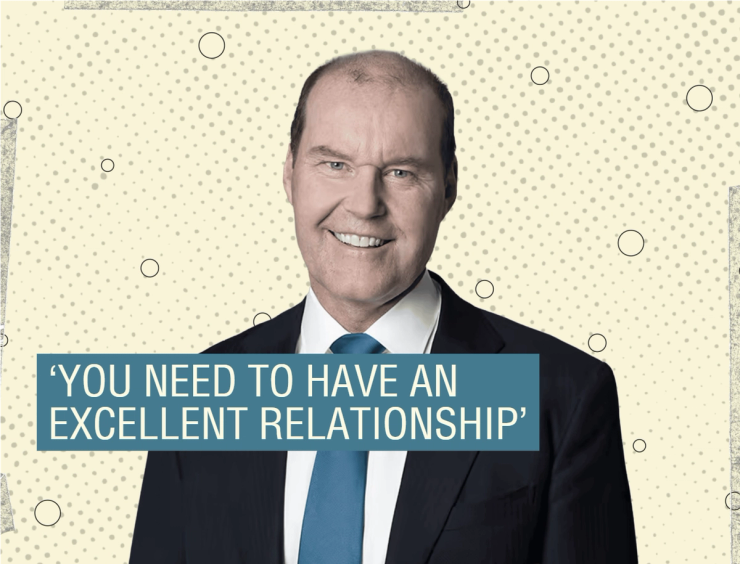
I’m still in charge of all the business decisions [even if] my successor is also very much involved. There is always this fear that you are a lame duck, but you need to have an excellent relationship with your successor. And the benefit of the company should be really what drives everything and not people’s ego.
You say Takeda is in an AI-driven transformation mode. Can you describe that?
Our goal is to double our research productivity [with AI], and on the development side, we are using big data and AI to optimize our clinical trial protocols. One of the big issues the industry faces is that it takes too long to recruit patients in clinical trials. It’s very expensive and it’s very slow. And so we are using big data and AI to optimize our clinical trial design and accelerate our recruitment of patients. For example, we have developed a new treatment to treat narcolepsy. And we have been able to reduce the [clinical trial development time] by about 30%, which has a huge impact.
According to one analysis, Takeda’s acquisition of Shire Pharmaceuticals created more revenue growth than any other large deal of recent years. What do you think went right with that deal?
When I joined the company, we had two ambitions. One was to become an innovation-driven pharma company. The second was that, in order to have a mission like that, we needed to be global and we were way too small in the US. At the time, the US was 15% of our global revenue. Now it’s 52%.
So we had started in that direction, and then Shire was an accelerator. It was not an opportunity, it was an accelerator within a strategy. And I think that’s the first very important point: To make a successful acquisition, it has to fit your strategy. After this acquisition, we were able to sell our generic [drug] business, and it moved our center of gravity quite a lot to the US, but we also more than doubled our R&D budget. Now we have eight molecules in late-stage [Phase III trials] with already positive readouts. There is no way we could have had this type of pipeline with the budget we used to have.
Does that success with the Shire deal give you an appetite for further M&A?
There is so much price pressure on the industry, and some companies will not do the AI transformation well, so my guess is that there will be more M&A. But that’s not our main focus right now. Our main focus is to launch our new products and to do the data technology transformation, and to continue to have a successful transition to my successor.

Notable
- Takeda pledged a US investment of $30 billion over five years last summer.