




The Signal Interview
The blandness of International Holding Company’s name belies the boldness of its ambitions. Founded as a fish farming business in the late 1990s, IHC has grown into Abu Dhabi’s largest listed firm and the second most valuable company in the Middle East after Saudi Aramco.
It is part of a network of entities controlled by Sheikh Tahnoon bin Zayed, the UAE’s national security adviser and the deputy ruler driving Abu Dhabi’s massive AI investments. IHC had assets of only a few hundred million dollars as recently as 2019, but its portfolio topped $125 billion as of September, and CEO Syed Basar Shueb plans to double its size again by 2030.
IHC’s partnerships with the likes of BlackRock and the US government’s development finance arm have already made it one of the Gulf’s most influential global investors. But Shueb says IHC is redefining the traditional holding company model, and its growth and profitability depend on something beyond dollars or dirhams.
With over 1,400 subsidiaries in more than 100 countries, from Alpha Dhabi to 2PointZero, IHC is “creating dynamic value networks using all the tools available to us,” he said in an interview at the World Economic Forum in Davos last week. And the principle of connecting companies, capabilities, and capital lies at the heart of its approach.
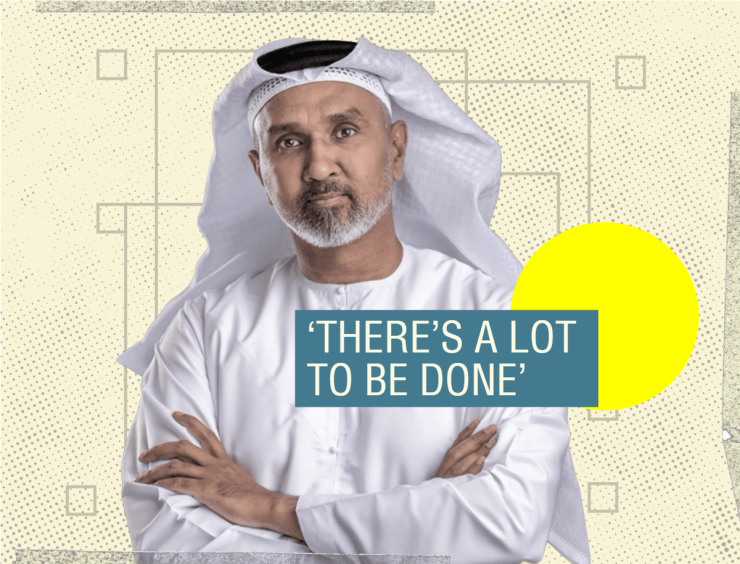
Shueb’s growth plan will see IHC deploy roughly $2 billion of fresh capital a month over the next four years. “Keep watching what we are doing,” he says. “There’s a lot to be done still.”
Turning investments into ecosystems
To explain what he calls the “ecosystems” IHC builds through its strategy of horizontal integration, Shueb takes the example of it buying a mining concession in a remote part of Latin America or Africa.
Right after opening the mine, he says, IHC would open an education business to improve the miners’ skills. Then it might open a health care facility and a football field to keep them healthy and engaged. “The community engagement becomes so important for us, and this is how we can expand everything,” he says.
IHC’s “dynamic value networks” are more difficult to deploy in developed economies, Shueb notes, but the model is one IHC has honed from sub-Saharan Africa to Southeast Asia.
“In Pakistan, we went into the university first, and then… banking; right after that, [we moved] into agriculture, because we have to feed those students somehow. And then we put [in a] data center so that these people can, once they graduate from the university, start using their modern infrastructure for themselves, so that they can develop things.”
IHC’s rationale is commercial, not charitable, Shueb stresses. “You will not hear me talking about philanthropy, you will not hear me talking about ESG,” he says. “What we are investing in has to have an impact on a population. … Money is a byproduct.”
Discipline, autonomy, and ‘the AI element’
Asked what allows IHC to make intelligent investments across businesses as diverse as an Indian mortgage lender, a Colombian food business, and a jiu-jitsu training company, Shueb replies: “Discipline.”
It is very focused on profit potential when making its initial investments, he says, “and then the same discipline is passed to our people.” More than half of the IHC leadership team has been with the group for over 20 years, he notes. “We give them the right environment to nurture, we give them the right advice and we give them the right direction, and then the team does the job.”
So while each subsidiary’s leaders are accountable to their own board, they are also expected to further IHC’s goals of creating “dynamic value networks.”
IHC’s constant reiteration of its strategic intent is key, Shueb says. “It’s a continuous follow-up, [with] very clear direction to the CEOs. You can ask any [portfolio company] CEO, what is the direction? I am sure that if you ask 10 of them, you will get the same answer.”
They might chafe at the repetition, he adds, “but this much clarity is there with them, that [any investment has to generate] a double-digit return; it has to have an impact on the population; it has to be scalable. It cannot be the defense business or tobacco. Other than that, the field is wide open.”
IHC’s portfolio is organized across eight sectors, from food and agriculture to hospitality and leisure. It is mapping its expansion plans onto core trends driving the world economy: growing consumer spending, and rising demand for energy and infrastructure.
But one other principle, apart from profit, now underpins its approach to any new investment.
“If there’s no AI, there’s no investment. Forget it. That’s a very clear direction,” Shueb says. For IHC to enter any new business in 2026, it has to see potential for “the AI element” to allow the business to expand faster, or break into new geographic markets.
Expanding impact through partnerships
Its newest vertical provides a case in point. Last May, IHC announced plans to launch a reinsurance platform, backed by $1 billion in equity and driven by artificial intelligence, alongside BlackRock and Lunate, an Abu Dhabi-based alternative investment firm. The new business, which aims to underwrite $10 billion of liabilities in the Middle East and Asia, has built AI’s capacity for improving data analytics and pricing into its systems “from day one,” Shueb says.
“This is what we are focused on, to have the best-in-class system developed for the insurance business by the insurance guys, not by some tech guy sitting somewhere and developing something which they don’t understand.”
The reinsurance initiative is also an example of IHC’s view that partnerships can help it unlock new markets. Earlier this month, it signed one such collaboration with the US International Development Finance Corp. to pursue investments of “mutual strategic interest,” and Shueb says he hopes to strike a similar agreement with a European government’s development finance arm this year.
IHC’s ambitions aligned with Washington’s desire to bolster key supply chains in areas from critical minerals to food security, and the backing of “a friendly nation where we can communicate easily” looked preferable to bank financing in certain markets, Shueb says. “If you have to choose your partner, can there be a better partner than DFC at this stage?”
The partnership should yield its first fruits imminently, he adds. IHC and DFC’s attempts to close their first deal were delayed by last week’s World Economic Forum annual meeting, but “hopefully, right after Davos, we will be working on a few transactions to close. I think by February, we should have at least one, if not three.”
A long-term view of global growth
IHC is shaping its portfolio around its view of where the strongest long-term global growth opportunities lie, from the energy transition to an aging population’s growing need for health care. Last year’s $1 billion investment in Indian mortgage lender Sammaan Capital, for example, was a bet on the rising demand for housing in the world’s most populous country.
Speaking in Davos last week, Shueb’s view of the world economy was that it will continue to provide benign conditions for an investor like IHC.
“There was a little bit of fog prior to coming over here,” he says, nodding to the tensions between Europe and the US over President Donald Trump’s demand that Washington take control of Greenland. But Trump’s speech dispelled Shueb’s concerns.
“It is clear for everyone that [there is] nothing to worry [about],” he says. “There is maybe a slight bubble in certain asset classes, but there is nothing major which can really shake the market. So we have, for at least the next three years, safe years.”
The gathering in Davos provides an opportunity to “feel the rhythm and the pulse” of the world economy, he adds, “and based on that, you fine-tune your next six-to-nine-month plan.”
But IHC is getting used to navigating through geopolitical tensions, and has built a level of resilience. There are “small fires” everywhere, Shueb says. “Any one of them can create a situation where we have to go back to the drawing board. But today, I don’t see we are, in any way or form, feeling any threat which can affect us.”
A bigger US-Europe clash would be the one exception to that rule, given IHC’s exposure to those two markets, but he sees such a blow-up as unlikely. “We have diversified enough that I think in the next few years, whatever the situation is, we will be growing.”

Notable
- Even as IHC’s portfolio expands, it is funding part of its growth with the proceeds of divestments. “First we try to buy the control, if we cannot and it is strategic to someone else, then definitely we will exit,” Shueb told Reuters in November, detailing plans to dispose of $20 billion to $25 billion of minority holdings over the next 18 months.