




The Signal Interview
This moment in US financial history has been called the best time in a generation to be a banker.
“They keep telling me that,” Brian Moynihan says with a wry smile — indeed, similar headlines appeared last year, and even in 2009, in the midst of the global financial crisis.
Moynihan has a longer view than most of his peers. He has held the top job at Bank of America, the second-largest US bank by assets, since 2010. Doing so has required a sharp eye on economic cycles, a rapid acceleration of BofA’s technology spending, and an effort to steer his 213,000-person bank through often treacherous political conditions.
Speaking at Semafor Haus in Davos this week, the day before President Donald Trump addressed the World Economic Forum, Moynihan betrayed no anxiety about the political climate. A year earlier, he was one of a small group of peers picked to question Trump when the president beamed in from Washington during his inauguration week. Moynihan lobbed a softball about the outlook for the economy, only for Trump to shoot back with a claim that Bank of America had been “debanking” conservatives.
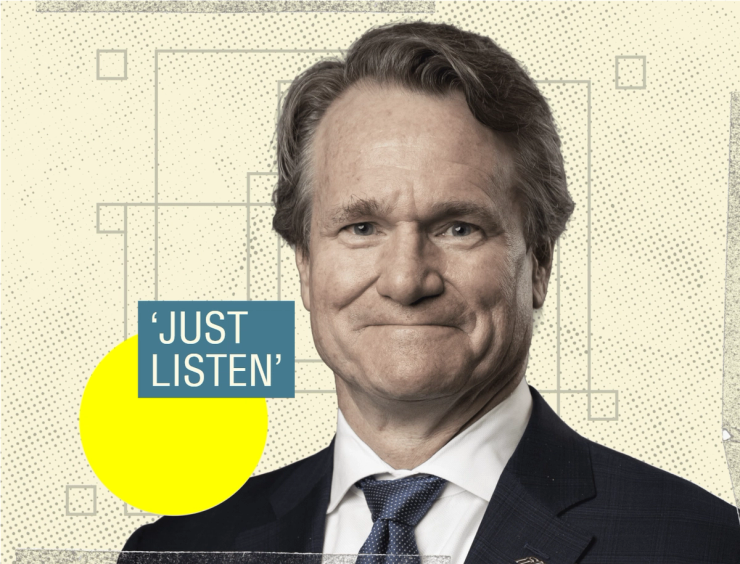
Moynihan was not at the president’s post-speech meeting this year with CEOs. His absence was reported as a snub by the White House, but the event coincided with Moynihan hosting clients — and US Commerce Secretary Howard Lutnick. Bank of America declined to comment, but Moynihan said when it comes to the president, his policy is: “Just listen.”
Whatever his standing in Washington, he remains a relentless cheerleader for the US consumer economy, and says corporate America has absorbed the geopolitical and tariff shocks of the past year, setting his bank up for a strong 2026.
Here’s how he explained the economic, political, and leadership balancing act he has pulled off for longer than any top US banker bar JPMorgan’s Jamie Dimon.
This interview has been edited for clarity and length.
Andrew Edgecliffe-Johnson: I read last week that this is the best time in a generation to be a banker? Does it feel that way to you?
Brian Moynihan: Look, why is it the best time to be a banker? The theory is that the regulations are swinging back to the middle because they swung too far. That takes pressure off. But the real best time to be a banker is when the economy’s decent. If the economy’s in good shape, then generally the banking system will be in good shape. And then you’ve got to be, in good times, able to position yourself so that when the economy’s not in good shape, you remain in good shape. And that’s one of the tricks.
You’ve been on the record saying you are bullish for 2026, for the US economy in particular. Can you break that down?
If you think about the economy globally, we have it [growing] in the [mid-3% range] for the year. In the US, right after the [2024] election, people had the economy growing about two-and-a-half percent in 2026. Then during 2025, you had that go all the way down to about 1.5% and then all the way back up and just recently last Friday, [analysts raised their forecasts to] 2.8%. What’s causing that? One is the sorting out of the major policy implementations. One was the tax bill, the second was trading tariffs, the third is the regulatory side, and the fourth is immigration. And while they’re still talked about and written up a lot about, a lot of it’s actually settled, in that people can predict a business plan and then go on.
This time last year, there was an expectation that deal activity would be unleashed. That was set back by the tariff story, but by the end of 2025 we saw some pretty big deals. What are you expecting now when you talk to corporate clients about the level of activity?
The tariff regime in the US that surprised everybody last April had settled into basically being around a 15% level for almost all activity by the end of the year. So I think corporate America absorbed all that. And as we went through the year, you saw more investment banking activity, more deals announced, the IPO market started to come to life. So, as we look at next year, our investment banking teams would look around the world and say, the pipelines are full. The activity’s not only in the US; it’s IPOs, it’s European-based activity, it’s multinationals buying. It’s clear you can get a deal done now. So it’s worth trying to do one.
Taking on board the fact that predictions for the year made in Davos are not always proved out, what could change the picture?
We still have wars going on that we are trying to sort through, whether it’s more tariffs, or debate that causes people to pull back and try to figure it out again. But at the end of the day, are consumers in the two largest economic blocks, the US and Europe, going to feel they’re employed and earning money and spending? Because once they do that, the economy turns.
Longer-term, debt levels around the world are problematic. I think governments know that and they’ve got to keep managing through. That’s not a problem, necessarily, for the first quarter of 2026. But governments around the world have to make major adjustments because the amount of debt issued around the COVID crisis, to basically win that war and spackle over a huge pothole and make it more smooth, hasn’t been pulled back out yet.
I believe you’ll be in the audience for the president’s remarks [on Wednesday]. What do you want to hear?
Nobody knows what he’s talking about tomorrow because originally it was going to all be about US domestic policy around affordability, and then now [it’s about] Greenland. So, wait and see. I think it’ll be fascinating as always, and I think he’ll cover what’s on his mind. He was here twice before and I think what’s on his mind is — there’s no debate. He’ll say it. So just listen. People always ask, what does he mean? Just listen. He’ll say it.
You spend $13 billion a year on technology. What have you done to try and create an innovation and technology culture in Bank of America?
We don’t take rare earth magnets and put them into this and make that, or we don’t take steel and make a car out of it. We basically are a one-zero processing company. It’s either by this brain [he points to his head] or by the computer’s brain. So we’ve invested heavily in a lot of digitization, and my entire career in banking has been about technology application, despite what people think.
The question is what the customer’s going to do. And the mistake people make is [saying] “customers want to do it this way.” There are still people who get cash out of ATMs — that’s 200 million a day — and there are people who never carry cash around, and everything in between. So the question is, how do you follow the customer, lead the customer and invent and make it work? But it’s more of an integration model. It is a straight-rate model for an idea because an idea is an idea, an applied idea is money, and our job is to take the best ideas, whether invented by our people or others, and apply them in a way and a scale that other people can’t.
What have you learned about pointing 213,000 people in the direction you want them to go in and actually having them follow?
You have to have people committed to the purpose and the mission of the company. That sounds trite, but it really is important when you have this many people and this many customers and this many things that happen a day. And part of that mission is you have to understand process. Everything has to be done through a process with controls around it. And so what seems conservative is actually enabling, because if you know the process is going to run, then you can do more and push harder.
[And then it’s] letting the competitive spirit and the talent of those 200,000 people bloom and that’s who you hire, how you hire, how you train them, how you allow them to be who they are and be successful in the way you pay them. It’s getting people to understand that they’re there to serve the customers well and also create economic value and then to do it the right way [by supporting] their communities. And if you do that, then you can run a big company.

Notable
- Both BofA and Citigroup are considering offering credit cards with interest rates capped at 10%, a concession to Trump’s recent demands that banks put a ceiling on credit card interest rates, Bloomberg scooped.