




The Signal Interview
The Nasdaq Composite is a whisker away from breaking another all-time record. The company that runs it is also riding high.
Last year, CEO Adena Friedman landed some prominent wins for the highest profile part of her business, most notably when Walmart — the world’s largest company by revenues — switched its listing from NYSE after more than 50 years.
Now in her ninth year in charge, Friedman is courting the could-be biggest IPOs of 2026 — Anthropic, OpenAI, and SpaceX. Her bigger project, though, is putting AI at the center of a cultural transformation of Nasdaq, while pitching the message that the technology will not realize its potential without the public markets on which its fortunes depend.
This week, Friedman used a start-the-year note to hone that argument, pushing back against those who see a bubble in AI-driven stocks. The investment required for this step change in technology represents a smaller percentage of GDP than past tech buildouts, she argued, and has been driven by companies — and investors — who have more than enough cash. The circular financing agreements that have troubled some commentators are, she said, justifiable as they help create the ecosystem needed for AI to take hold.
Here’s what she told an audience at Semafor Haus in Davos this week about how she sees the future of capital markets and the global economy.
This interview has been edited for clarity and length.
Andrew Edgecliffe-Johnson: Your annual note contains a multifaceted argument for why you don’t see a bubble out there. Can you give us the shorter version of that?
Adena Friedman: We decided to focus [the note] on AI because of course I think that it is the technology that’s going to transform business. The entire management committee did a debate and we started talking about all the different elements of the AI buildout, the AI infrastructure, the use cases, what’s holding people back from deploying it at scale, what’s it really going to take to make it as transformational as it can be. And I think that the net result is that you have to take the long game here. I mean, it’s a marathon. We’re at the beginning of a marathon and we’re sprinting pretty hard, [and] the infrastructure that needs to be built out is striking. But it is also not unique. We’ve seen this back in the dawn of the railroad and the dawn of other technologically transformational times, including the internet, where the rails have to be built, and that requires an enormous amount of capital investment. But the difference between this time and the last several technology transformations is that the fundamental players who are building those rails are incredibly well capitalized.
They’re good for the money?
They’re the largest companies in the world. If you look at all of the money that the hyperscalers and large [semiconductor manufacturers] have invested, just in building the infrastructure in 2025, it represented less than 68% of their annual cash flow. That’s how cash-generative these giant companies are that are building out this infrastructure. But in order to really build it out at scale, we all know we’re going to have to diversify the capital pools. Over time, we do think that the public markets are going to be critical.
You’re saying the vast majority of this has been funded so far through private markets, but the next phase will require a much greater involvement from the public markets. Why?
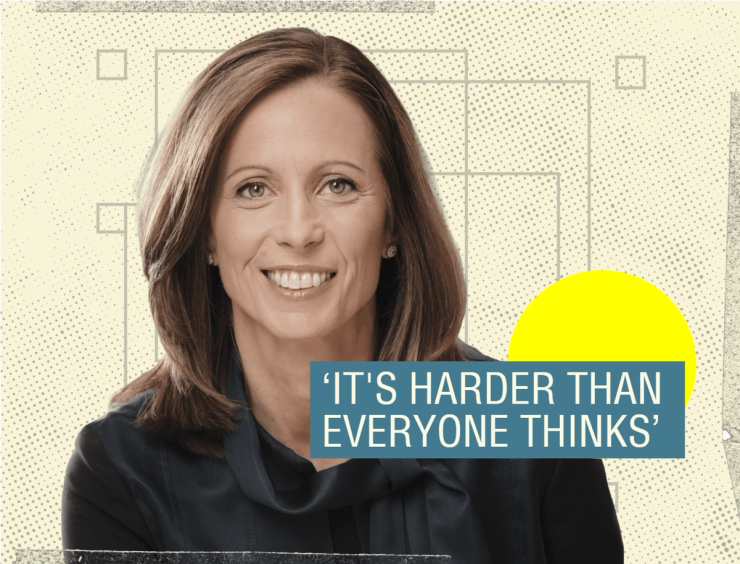
It’s a natural progression of any major innovation to continue to diversify the pools of capital that are underwriting the investment that’s needed. Then you’ve got all the companies that are going to ingest this new technology and have to drive change across their enterprises. What’s it really going to take to scale it so that AI reaches its potential? And our view is enterprise implementation is going to be the catalyst. And that is hard, and it’s harder than everyone thinks it is. And that’s why you need broad-based investors to help manage that investment.
You’ve personally taken command of Nasdaq’s AI strategy. Why did you feel you needed to do that?
There’s a point at which you just need to start driving really fast. So we started with making sure we educate and introduce and allow experimentation. We took 2023 and 2024 to really drive that experimentation. We ran eight hackathons across our global workforce, just to show how the technology can be used to drive outcomes. But the real issue of enterprise adoption is a massive change-management exercise. And the only way that that’s going to happen is with the CEO driving it. So now that you’ve got the experimentation done, you take the fear factor out, you talk about and you showcase how it can make everyone’s work life better, easier, more productive. And that requires an enormous amount of focus.
One of the highlights of last year for you was landing Walmart. How did you pull it off and why did they do it?
I had a chance to go to [Walmart’s headquarters in] Bentonville, well before they made the decision, just to understand the culture of Walmart. Anytime you have a $800 billion company deciding to switch listings, the CEO is going to be involved. So we developed a very good relationship across the leadership team. Second, it’s about shared values, and that’s why going to Bentonville was so important to understand how our organizations are aligned. The third is about the flat-out value proposition. And I think there were three legs to the value proposition that resonated with them. The first is the index, because [when they join the Nasdaq 100] we become a new investor in their shares. I think the second is the brand alignment, and then the third is the trading performance. And we were able to demonstrate that for megacap companies particularly, the quality of trading and the cost of capital is significantly lower on Nasdaq versus our competitor.
One of the questions hanging over 2026 is whether we see IPOs for OpenAI, Anthropic, and SpaceX. Are you having the same conversations with Sam Altman, Dario Amodei, and Elon Musk?
We don’t talk about specific companies but as we position ourselves to be the home to all these amazing innovators, we are heavily engaged across the ecosystem. We work very hard to build relationships years ahead of an IPO. We don’t like to be just, “oh, let’s meet the CEO during a bake-off.” We like to develop those relationships, develop trust, understand the commitment that we can make and they can make, so that when that decision is made, hopefully, they see it as a natural decision.
In your note, you paint a very optimistic outlook for the conditions you’re operating in. What do you think could undermine it?
First of all, I think all the time about how to go faster within the realm of what I can control or we can control as a company. It’s [about accelerating] the pace of adaptation, change management and product road maps. I spend the vast majority of my time worrying about that. But there are of course all those things that you can’t control and you can get very distracted and it can be heavy and you can start your day feeling very heavy, yet you can’t control those things. Of course we scenario-plan around different externalities that could come, but we also try to put them into perspective as to what could impact [us] and what could not. Obviously, geopolitical harmony is good for our business.
You’re a global business. We’re at the World Economic Forum. What’s going to be the most exciting capital market outside the US this year?
Nasdaq also owns and operates many of the markets in the Nordics, including the Swedish market. Sweden is the shining star of Europe. It is incredible. We had the largest IPO in Europe over the last three years — Verisure went public in Sweden, even though it wasn’t a Swedish-based company. Household ownership of equities in Sweden is almost exactly the same as the United States. It’s twice as much as the rest of Europe on average and three times as much as the UK. I cannot take credit for that. That is all about government actions, government policies, a risk culture, tax policies that really encourage equity investment. I would say, everyone should be looking to Sweden to ask, how can they make European markets the most vibrant in the world?

Notable
- Friedman told Bloomberg at Davos that Nasdaq is “very aligned” with the SEC under President Donald Trump on “ways to reform proxy, ways to reform disclosures, and even ways to consider changes in litigation for the public company model” to make going public more attractive.