




The Signal Interview
When Southwest Airlines rolls out assigned seating and the chance to buy seats with extra legroom on Jan. 27, it will cap what Bob Jordan calls a historic transformation of the budget carrier’s way of doing business. Almost 55 years since Southwest’s first flight took off from Dallas Love Field, its CEO has abandoned its distinctive embrace of open seating, single-class cabins and letting customers check two bags for free. At the same time, he has expanded ticketing beyond Southwest’s own website to travel sites like Expedia, and broached the idea of opening airport lounges – something the no-frills pioneer once shunned.
“It’s the most remarkable set of changes I’ve seen, not [just] Southwest, [but] any airline do in the course of a year in my 38 years in the industry,” says Jordan, who became CEO four years ago. They are being implemented on schedule and producing the results he hoped for, he adds. Southwest’s stock, which fell so badly behind rivals after a fumbled response to a harsh winter storm in December 2022 that an activist investor laid siege to the company, outperformed its peers over the past year as the airline reported record revenues. But Jordan also signed off on another break with Southwest’s history in 2025: its first-ever layoffs.
The airline, which had bucked its industry by holding onto employees after the Sept. 11, 2001 attacks, the 2008 financial crisis, and the 2020 pandemic, axed 1,750 corporate and leadership roles last February. Those cuts shielded pilots and flight attendants but posed an uncomfortable question: Is Southwest now just like the legacy airlines that Herb Kelleher, its late co-founder, set out to disrupt?
Harnessing two storms to raise the pace of change
Jordan’s rethink was far from unprompted. At the end of his first year as CEO, a blizzard known as Winter Storm Elliott triggered an operational meltdown, stranding thousands of Southwest customers at the height of the holiday season, paralyzing the company’s point-to-point network, and plunging the company into a profit-killing crisis. A little over 18 months later, the activist investor Elliott Investment Management built a stake in Southwest and launched a withering campaign that called for sweeping board changes, including the removal of Jordan and his then-chairman, Gary Kelly.
Jordan insists that the changes he has ushered in over the past year were underway before Elliott’s pressure campaign, which ended in October 2024 with the airline agreeing to add five of the investor’s nominees to its board. But both moments “injected urgency and pace,” he concedes.
“I think we’ll look back and [say that] Elliott 1, the winter storm, [and] Elliott 2, the activist, are two of the most important things that happened to Southwest Airlines, not because they affected what we did, but because they affected the rate of change,” Jordan says.
Chasing the customer without losing the core culture
What Jordan calls his evolution of the business model is about reckoning with changing realities and “chasing what our customers want.” Southwest’s open-seating policy had become a deterrent to passengers who prefer to choose their seats, he notes, such as families wanting to sit together.
“You can either be honest with yourself and understand what you need to do, consistent with your model, to meet [passengers’] needs, or you can ignore that and get further and further behind your customer. And at some point, your customer has left you because you’re not meeting their needs any longer.”
Behind Kelleher’s eye-catching fares, irreverent stunts, and “employees first” mantra lay a ruthless understanding of the economics of aviation. Flying a single type of aircraft, turning planes around in a matter of minutes, and not spending money printing boarding passes all kept costs low and operations simple. So Jordan’s overhaul challenged both a distinct corporate culture and a revered business model.
“I’m asked a lot, ‘Are you just becoming a legacy [airline]?’” he admits. But he maintains that Southwest’s core strengths have emerged unscathed. The core of Kelleher’s strategy was differentiation through low prices, reliability, and fun-loving staff who are “not stodgy like all the other airlines,” he says, and those distinctions remain.
Jordan, who joined Southwest in 1988, remembers when it abandoned other traditions such as handing out peanuts and plastic boarding passes. He knows the risk in making such changes, because each time he heard the cry: “There goes Southwest.” But he says leaders must be willing to change while staying clear about what is essential to their company’s culture and what is not.
“The great thing about being successful is you’re successful. The bad thing about being successful is it’s easy to stand still,” he cautions; companies need to challenge themselves when things are going well if they hope to stay innovative. Adding bag fees was a “difficult” change, he notes, but Southwest has not seen customers defect to other airlines.
Hard data and soft skills behind an operational overhaul
Jordan is conscious of the risk of adding complexity to Southwest’s tightly-tuned operations, but said it applied technology to the “friction points” that could slow it down. The company ran millions of simulations to study the likely impact of introducing assigned seating and changes to bag checking. What it found was that the scramble for seats, which used to let its aircraft take off faster when they were only 55% to 60% full, had begun to stretch its turnaround times as passenger loads grew to 90%. “This is counterintuitive, but all the modeling tells us that boarding and turning the aircraft under assigned seating is actually faster,” he says.
AI-powered models can now take into account variables from how full a flight is to what time of day it is leaving, and advise staff ahead of boarding time how many bags they are likely to need to check at the gate. Passengers now get messages inviting them to check their carry-on bag if overhead bins are filling up.
Having the technology to support such changes was only half the battle, however. Upending how a company of 72,000 people operates requires a process that “brings [employees] into the change so they’re part of it, and it’s happening with them, not to them,” Jordan says. His way of doing that “is going to sound dumb, simple, stupid,” he warns: “You have to communicate, and we probably overcommunicate.”
So, once a week, Jordan pulls his phone out to record a short video message to explain to employees what Southwest is doing. He has also given his phone number to hundreds of them, he estimates, and invited their feedback. The accessibility is rarely abused, he says, and “you want to hear the unvarnished truth.”
Strong cultures can help ensure that everyone is aligned behind a company’s mission. But strong cultures can also make things difficult for leaders who try to usher in changes. So Jordan makes a point of serving snacks with flight attendants, loading suitcases with baggage handlers, and sitting in breakrooms talking to ramp agents. Listening to frontline staff has deepened his understanding of the challenges they face, he says, while helping him make the case for the strategic shifts he has pushed through.
“They trusted the plan because they trusted me,” he says. “I think the [view that] ‘Bob’s out here with us’ creates some credibility that I’m not just sitting in an office way up in Dallas, throwing edicts down.”
That accessibility needs to be paired with accountability, however. Jordan’s brushes with “Elliott 1 and Elliott 2″ taught him that CEOs need to take responsibility for their company’s failures, and their toughest calls, he says.
“When the decisions are the hardest, they’re emotional, they’re about people, you need to make them,” he says. So when Southwest’s leadership began discussing possible layoffs, “I wanted it to be my decision and no one else’s… The accountability needed to be with me.”
The message to his senior team members, he says, was: “Don’t you go home feeling guilty. You let Bob take that weight off our people, and you just execute this.”
CEO ‘think time’ and the founder’s legacy
In the top job, Jordan explains, “you quickly realize that you’ve got to decide what can only you do as CEO.” He has always been detail-oriented and found it difficult to turn down people who want his time, he says. But that insight helped him realize that if he is not staying focused on the decisions that only he can make, he risks “holding the whole company up.”
Finding that focus has been a challenge. “Life and leadership teaches you that leadership equals busy,” he remarks. But, after 38 years of feeling guilty about the time he wasn’t spending in meetings or out with employees, he recently decided to put three or four hours of “think time” on his calendar each day.
CEOs need time to step back and think about what is happening around their company, where it needs to go, and what its priorities should be, he reasons. “If you don’t do that, you’re hurting the company… and you’re probably hurting your family” by working on those challenges at night and on weekends instead.
“You just have to be manic about managing your time to the most important things,” he says. “I get more out of my open time for the company than all the meetings that I’m in.”
Memories of Kelleher loom large in Southwest’s Dallas headquarters, which still contains a replica of his office. But Jordan says it’s a mistake to assume that Southwest’s co-founder would not have shaken the business up as he has done.
“We’d never be in New York, we’d never be in Philadelphia, we’d never be in Los Angeles,” he says, rattling off examples of things Kelleher foreswore that he ended up doing. “I’m convinced that Herb used the ‘we will never’ as a way to keep people focused, and to keep that nonsense or that distraction out of the day-to-day until we were ready.”
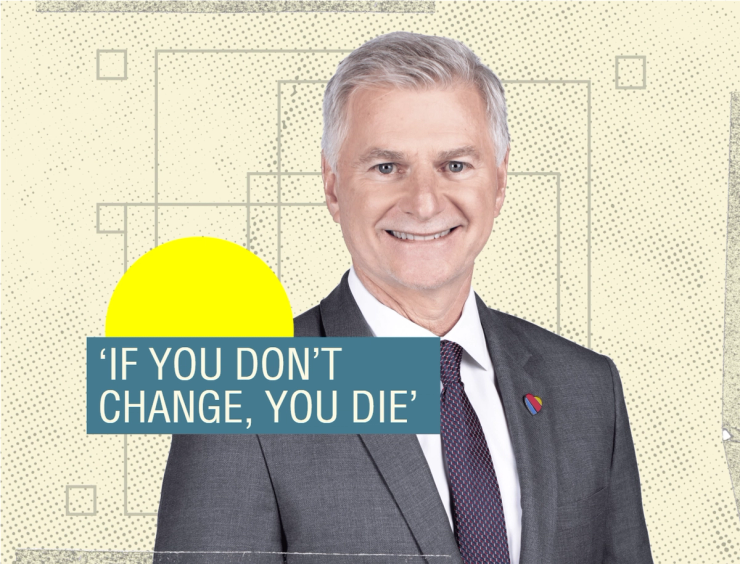
The thought prompts Jordan to recall one final quote from his charismatic predecessor: “If you don’t change, you die.”

Notable
- Southwest added additional flights to its Caribbean routes to compensate after the Federal Aviation Administration briefly closed airspace in the region due to US military action in Venezuela.
- Southwest is also discussing airport leases and lounge possibilities, along with its credit card partner, Chase. The Dallas-based airline in October won approval for an airport lounge at Honolulu’s Daniel K. Inouye International Airport.