




The Signal Insight
Ferrovial’s inclusion in the Nasdaq 100 index last month marked a milestone in the Spanish company’s journey to reinvent itself as a global infrastructure player. Under Ignacio Madridejos, its CEO since 2019, the onetime supplier to Spanish railways has become one of the leading infrastructure companies in North America, with a pipeline of projects from power substations to the soon-to-open Terminal 1 at New York’s JFK International Airport.
Much of that growth has come from drivers, from Toronto to Texas, who are tired of sitting in traffic. Ferrovial’s decades-long agreements to operate toll roads around cities, including Charlotte and Dallas-Fort Worth, now underpin 80% of its valuation, Madridejos says. Its ability to set prices under several of those agreements has driven its revenue per trip substantially higher in recent years. For the first nine months of this fiscal year, its revenues from those express lanes jumped 16.4%.
That record is catching the eye of growing numbers of US investors. Ferrovial gained a US listing in May 2024, becoming the first company in Spain’s IBEX 35 index to trade its ordinary shares on Nasdaq. Since then, its stock has outpaced major indices, rising 57% last year to lift the group’s market value to €42 billion.
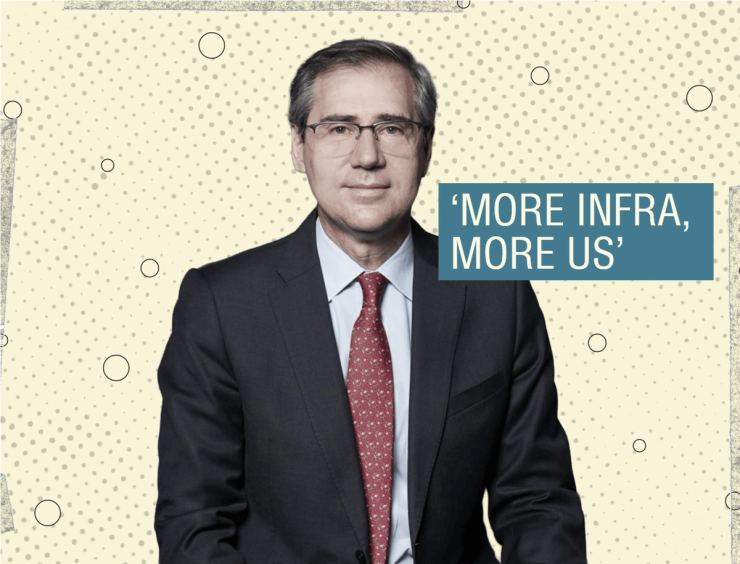
Madridejos, a civil engineer who joined Ferrovial’s construction business in 1990, worked for McKinsey and Cemex, the Mexican building materials group, before returning to lead the company that trained him. Having sold Ferrovial’s services businesses and disposed of its stake in Heathrow Airport, he says its current focus is where it sees the most opportunities. Ferrovial’s future, he says, is “more infra, more US.”
This interview has been edited for length and clarity.
Andrew Edgecliffe-Johnson: What differentiates Ferrovial?
Ignacio Madridejos: We participate in the whole cycle — the conceptualization, the design, the financing, the construction, and the operational maintenance of the infrastructure. And where we position ourselves is mainly greenfield infrastructure. Infrastructure funds usually don’t participate in this type of project because they don’t understand construction risk. And construction companies don’t usually contribute equity to develop projects. So we are in a nice niche in the industry, and we have iconic infrastructure assets that are growing above GDP and inflation.
Your latest results showed strong growth in revenue from North American roads. Why the change?
We are in cities that are growing and have a lot of economic activity. With that growth, what you see is more congestion. And when you have more congestion, [that increases the] value of our assets. The value of our assets comes from reliability, time savings, convenience, and peace of mind. Even if the general purpose lanes are completely free, people sometimes use the managed lane. Some people prefer it because of safety, or because they can go faster than in the general purpose lane. So for several reasons, they see value. And we can capture that value to users because we have, in three of the assets, freedom to set toll rates.
Is there any economic sensitivity to drivers’ willingness to take the toll road? Have you seen through economic cycles that people choose to take the scenic route if they’ve lost their job, or if they’re worried about the economy?
Yes, it’s very related to GDP. Of course, traffic in general is very related to GDP. And what we have, which is quite unique in our managed lanes, is dynamic pricing. So we change the price every five minutes, based on the perception of the value that it has for the user at the specific point of time. So for us, [demand and pricing] is more about the congestion and how people understand the congestion of the specific road in which we have operations.
Why, when you have a whole world you could invest in, does the US look so compelling to you right now?
The role of private players is going to be critical in order to develop [US] infrastructure. There is a $4 trillion [gap in the funding required for US infrastructure investments by] 2040, there are fiscal deficits, and some states don’t want to raise taxes and they want to accelerate infrastructure. So it’s the right combination for private partners to come and deliver that infrastructure faster and more efficiently.
Why do you need three listings?
We identified that 80% of [our] value is in North America, [and most of our] growth was going to be in the US, so the value that we could create by being listed in the US was clear. Once we took that decision, the question was: “How do we do that in the fastest way?” We wanted to be listed in the US with ordinary shares, not ADRs, and we wanted to be considered as a US corporation so funds that have a US mandate can buy our stock. When we analyzed that, it was not feasible to do it from Spain. There was no direct connection. So we decided to take the route that other companies had taken: We listed in the Netherlands through a reverse merger, and at the same time listed on Nasdaq. It was a known route, and we decided that was the safest and the fastest.
What benefits has the US listing given you?
In terms of liquidity, it has been very relevant. We have maintained the same liquidity we had in Spain, but now we have, on some days, even more liquidity in the US than in Spain. What you see is that two thirds of the capital markets are in the US, and the number of investors is endless. I mean, every day you can find new investors that you didn’t know before. I think this is amazing.
And does it still make sense to keep the Madrid and Amsterdam listings?
It depends on our investors. Things may change, but so far we have European investors that are happy and they are trading there, and we are adding new investors in the US.

Notable
- Ferrovial sees more opportunities for investment in US airports beyond JFK, Madridejos told Reuters, even after a drop in travel to the US that has been attributed to inflation and tighter US immigration policies.
- Toll roads are proliferating in the US, The Economist reports. The idea of funding highway maintenance by charging drivers has found bipartisan support as the idea of raising gasoline taxes to fund highways has come to look like “political suicide.”