Students won’t learn without exercising their brains, “in the same way that we do not become fit by watching sports but by doing sports,” wrote an OECD researcher in a recent report. Students who refrain from using AI perform better academically than those who use it, according to the report, which surveyed more than 760,000 students across 91 countries. Researchers found that consuming information that doesn’t require any “cognitive struggle” proved an ineffective educational method.
After a decade-long push to integrate technology into classrooms, educators are now reversing course. Twenty-two states and Washington DC have mandated bell-to-bell phone bans, and for the first time this school year, New York City’s and Los Angeles’ public schools are implementing restrictions on AI use, impacting more than 1 million students combined (New York also prohibited teachers from using AI to grade assignments).
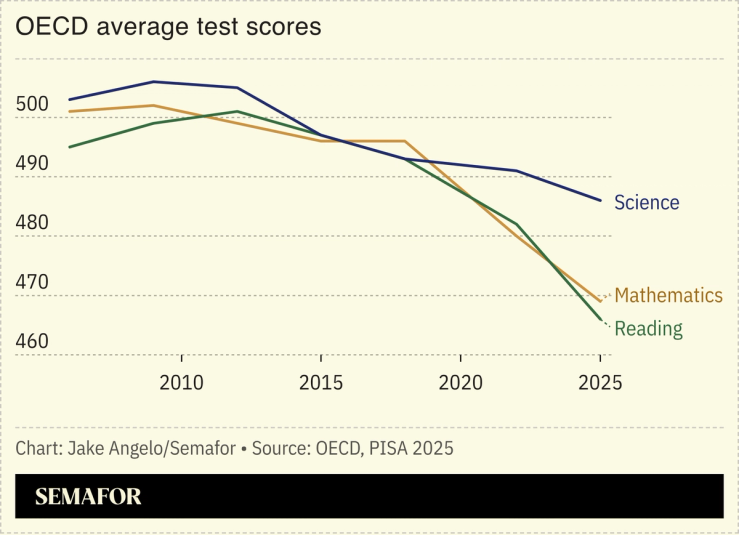
Edtech may have already failed to support learning, though. Reading, science, and mathematics scores have fallen steadily over the past 15 years before widespread AI adoption. Education is best done offline, like it was before the advent of the personal computer. And technology has gotten so user-friendly, it isn’t necessary to instruct students on how to work with it. Plus, most young people are better versed in AI and smartphones than their parents and teachers.